Get Full Government Meeting Transcripts, Videos, & Alerts Forever!
Get email alerts on the Assessments topic
No spam. Unsubscribe anytime.
Board reviews assessment data; district to align local diagnostics on MAP Growth and add screening for early grades
Summary
District staff reported modest proficiency gains overall, flagged drops in some elementary grades, and described assessment-platform alignment (MAP Growth) plus new screening and intervention strategies, including co-teaching and added teacher positions to reduce class sizes.
Wicomico County Public Schools staff presented end-of-year local diagnostic results and outlined assessment changes and interventions for the coming school year.
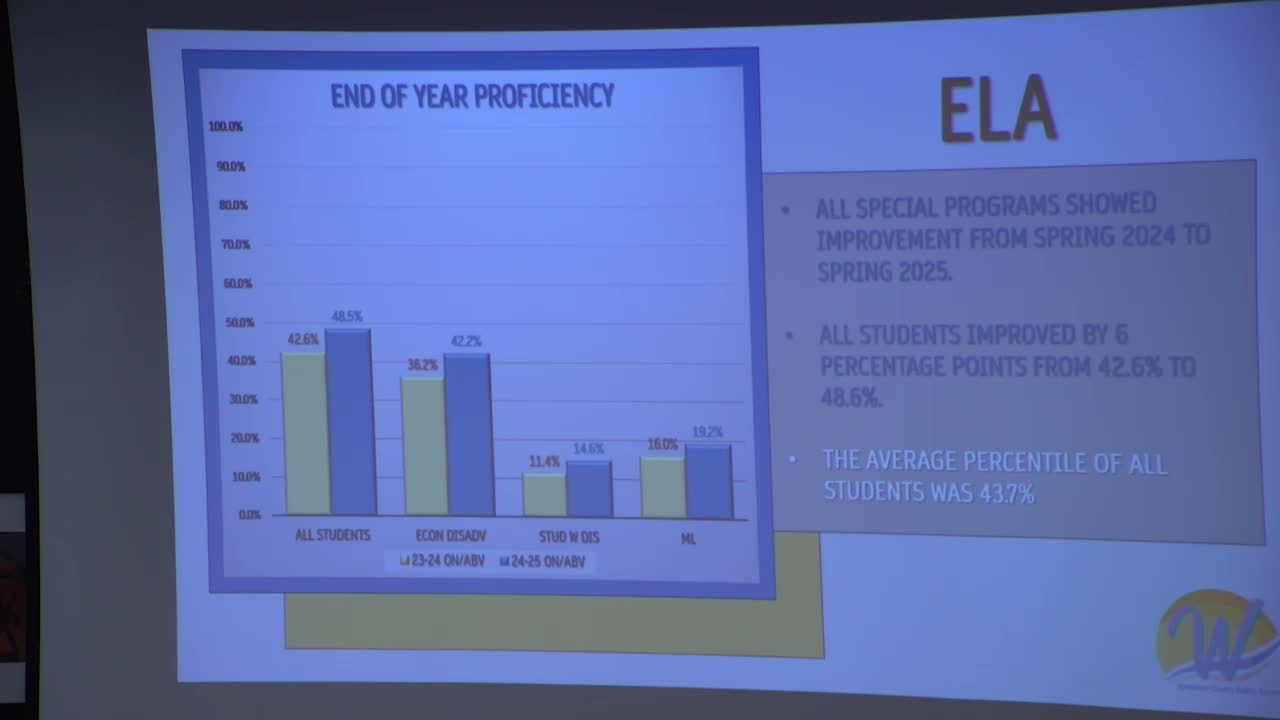
Speaker 11 (district assessment lead) reported overall proficiency gains across tested grades, noting a combined K'English 10 proficiency increase from 42.6% to 48.6% year over year and an average national percentile near 43.7. Kindergarten proficiency remained high (about 73.6% on local diagnostics) and third grade posted a notable 55% proficiency level. The presenter cautioned that local and state platforms differ and that some measures remain provisional until the state finalizes MCAP results.
The board pressed staff on an observed decline in fifth-grade ELA (reported at 36.2% proficiency compared with roughly 48% two years prior). Staff said retention policies are under review and that the district will use fall diagnostics, state MCAP data and content supervisors'analysis in September and October to refine instructional directions.
The district will standardize its local diagnostics: kindergarten will resume the KRA, and the district will align ELA and math local diagnostics on MAP Growth across K through Algebra I to reduce platform complexity for teachers and families. For grades 1'3 the district will also administer a short universal screener to meet the state's Ready-to-Read requirements and to identify domain-specific concerns quickly.
Drew (speaker 12) presented math results, noting increases in grades 2'5 and cohort growth in middle grades; he said grade 5 showed an 11-percentage-point increase year-over-year and a cohort moving from grade 6 to 7 improved about 5.4 percentage points.
On supports for students with disabilities, staff described a co-teaching model emphasizing collaboration between special education and general-education teachers, plus partnerships with Johns Hopkins University and other technical assistance providers to use data-driven PLCs and targeted interventions.
Board members asked practical questions about instructional minutes and class sizes. Staff said elementary reading instruction averages about 120 minutes per day and math about 90 minutes, with approximately 30 minutes of math time set aside for small-group intervention. The district said the board-approved budget added eight teaching positions intended to reduce class sizes and that boundary adjustments were used to maximize existing classroom space.
Staff highlighted several "celebrations": 1,130 students took accelerated coursework; 676 students participated in AP course work and AP exam-taking; dual-enrollment coursework totaled 1,000 course seats (454 students); and CTE programs reported a 100% graduation rate among participants and a 90% industry-credential pass rate.
What happens next: staff will return in September with MCAP results and content supervisors for deeper analysis, then report fall diagnostic outcomes and any instructional decisions in October/November, and provide SSR rating reviews in December.