Commission approves 1,200‑acre conditional use for equestrian park with cultural‑resource, buffer conditions
Loading...
Summary
The Santa Rosa County Commission approved a conditional‑use request by Florida Ranch Development for an equestrian‑oriented active park on roughly 1,200 acres, attaching conditions including a 100‑foot vegetative buffer near residences, limits on RV stays, and a cultural‑resources survey to protect potential archaeological sites.
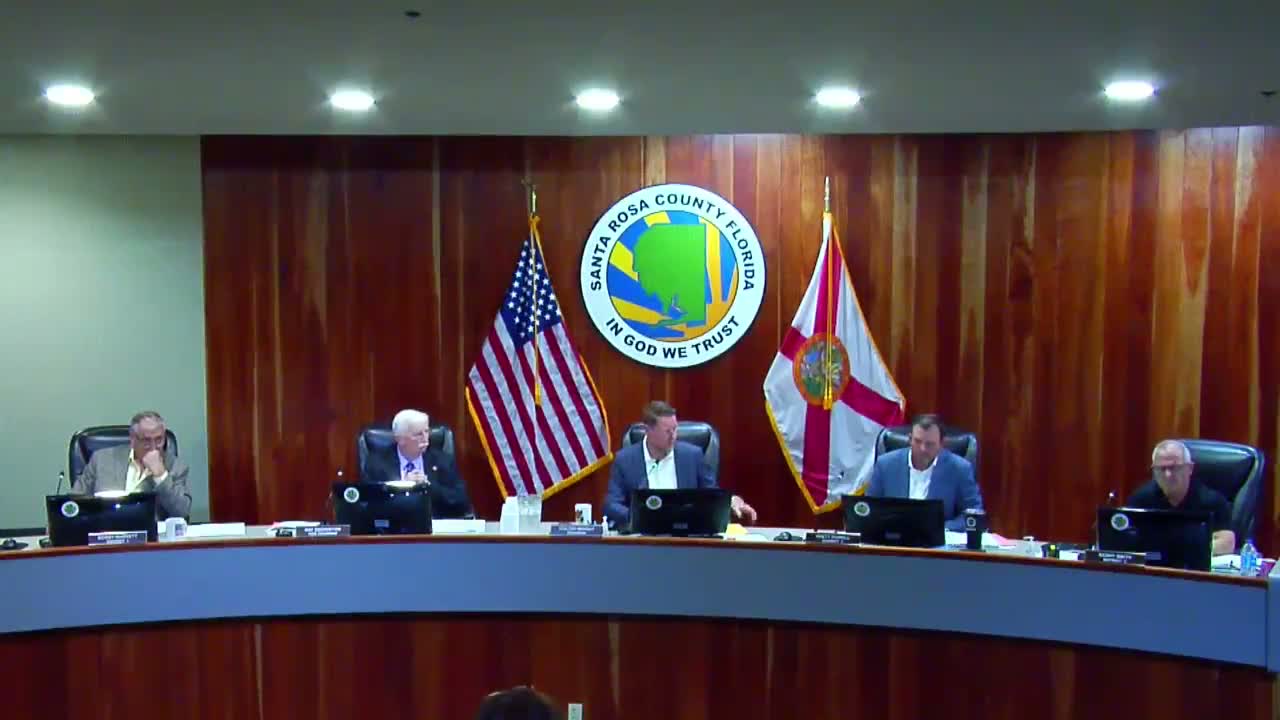
The Santa Rosa County Board of County Commissioners approved a conditional‑use application from Florida Ranch Development to operate an active equestrian park, campground and event space on about 1,200 acres after hearing extensive public comment and negotiating conditions.
Attorney Angela Jones (speaker 20) presented the project as agricultural and equestrian in character, noting a lengthy planning history and a site plan that included roughly 50 RV spaces intended for temporary event stays and not long‑term residency. Jones said staff analysis was positive and that the applicant would comply with required permitting, archaeological studies and site‑plan review.
Supporters said the project would expand local equestrian opportunities and preserve agricultural activity; speakers included employees and family members affiliated with the Hayes Ranch, and residents who ride and teach children to work with horses. Opponents raised concerns about the potential for the site to evolve into higher‑density housing or commercial development, event parking and traffic impacts, and the possibility of disturbing Native American cultural resources near the shoreline.
Dan Helms (speaker 22), who identified himself as chief of the Santa Rosa Band of the Lower Muskogee, told the board there is credible evidence of a possible Native American burial mound near the river edge and asked the county to require a qualified cultural‑resources survey and an avoidance plan before permitting shoreline improvements. Jones said the applicant already had an older archaeological study and would update it and comply with statutes and permitting.
Commissioners negotiated conditions including a 100‑foot vegetative buffer between built campsites or event structures and existing residential uses (excluding equestrian trails), limits on RV stays (the applicant indicated a 72‑hour maximum), prohibition on permanent mobile‑home style operations, and a requirement to conduct and, if necessary, update a cultural‑resources survey before ground disturbance near known archaeological features. After a brief recess for applicant and counsel to confer, the board approved the conditional use with the stated conditions and required compliance with state permitting for shoreline work.
The approval is conditioned on meeting development‑review requirements, the 100‑foot vegetative buffer as agreed, rules governing temporary RV stays, and completion of required cultural and environmental reviews.