Get Full Government Meeting Transcripts, Videos, & Alerts Forever!
Get email alerts on the Peak Health Report topic
No spam. Unsubscribe anytime.
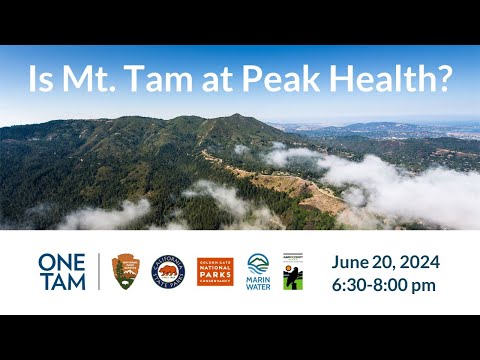
PEAK Health update: Mount Tamalpais’ overall condition remains “fair,” partners add bees, bats and giant salamander as indicators
Summary
A coalition-led update to the PEAK Health ecological assessment finds Mount Tamalpais’ overall condition is still “fair.” The 2023 report adds three new wildlife indicators (bees, bats, California giant salamander), highlights data gaps and calls for continued monitoring and coordinated stewardship.
The 1 TAM partnership released a 2023 update to its PEAK Health assessment, concluding that the overall ecological condition of Mount Tamalpais remains “fair,” the same broad rating the partners reached in 2016. Yolanda Mollet, director of conservation and community science at the Parks Conservancy, said the updated roll-up — based on 22 condition indicators and 2022 data — shows some species and communities doing well while others need attention.
"In our 2023 report, we found that the overall condition of the mountain is still fair," Mollet said, noting the update includes new indicators and improved mapping that complicate direct trend comparisons to 2016.
The report added three indicators that were previously data gaps: native bees, bats and the California giant salamander. California State Parks environmental scientist Bree Hardcastle described the salamander as an important indicator for headwater stream and riparian habitat and said community-science observations (iNaturalist) were used to fill distribution gaps. "They're one of the largest salamanders anywhere, and they also live year round on Mount Tam in headwater streams," Hardcastle said.
The partners combined fine-scale vegetation mapping, community-science data and expert judgment to generate condition ratings for eight vegetation communities and 14 wildlife species and communities. Examples cited: serpentine barren endemics were assessed as fair with a stable trend; oak woodlands moved from a declining signal in 2016 to a cautionary status in 2023; coast redwood forests showed no detectable change in the available data.
Speakers emphasized remaining unknowns. Mollet and others warned that rolling many indicators into a single headline makes detecting five-year changes difficult when the set of metrics and the geographic scope change between assessments. The report flags several continuing data gaps, notably lichens, hardwood forests, seeps and springs, and many invertebrate groups other than bees.
Community science bolstered some findings: Lisette Arellano, senior program manager for conservation and community science, said the partnership’s volunteer and crowdsourced efforts produced new inventories — including nearly 400 species of native bees recorded on the mountain — but stressed that more systematic monitoring is needed to establish trends.
The partners framed the PEAK Health update as guiding stewardship priorities rather than replacing agency management documents. Mollet said PEAK Health "does not supersede our individual agency policy" but provides a shared baseline and a platform for coordinated monitoring, early-detection rapid-response work and restoration planning.
The report and supporting materials are available at onetam.org/peakhealth; partners said the next scheduled update is planned in five years and that the report will continue to inform monitoring and priority-setting across jurisdictions.