Get Full Government Meeting Transcripts, Videos, & Alerts Forever!
Get email alerts on the Human Trafficking topic
No spam. Unsubscribe anytime.
Santa Rosa County proclaims January Human Trafficking Awareness Month; survivors urge training, local enforcement options
Summary
The Santa Rosa County Board of County Commissioners adopted a proclamation recognizing January 2026 as Human Trafficking Awareness Month. Survivor leaders urged the board to expand training for teachers and law enforcement and to consider local measures to help identify and respond to trafficking, while also proposing community reuse of the old courthouse to support survivors.
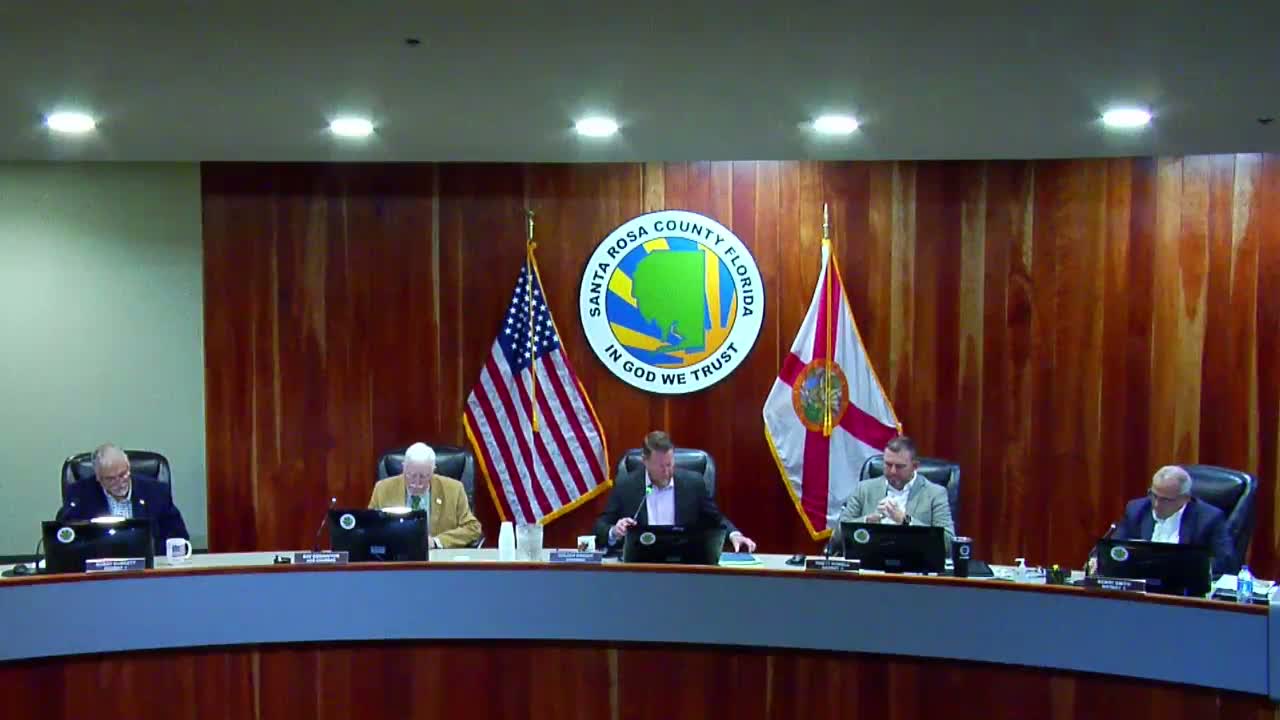
The Santa Rosa County Board of County Commissioners formally recognized January 2026 as Human Trafficking Awareness Month on Jan. 22 and invited local survivor leaders to tell the board about services and prevention needs.
A survivor‑services leader who identified herself as representing Survivor Lehi Solutions and the Blessing Boutique said local groups provide immediate needs and referrals and urged broader prevention work. “We worked with 2,000 women last year in 2025 in our area,” the presenter said, describing clothing, referrals and mental‑health connections her group provides.
Rhonda Fisher, who said she is the first survivor to serve on the executive board of the Circuit 1 Human Trafficking Task Force, told commissioners training is essential and urged a community approach. “I would love to sit down and have that conversation,” Fisher said, offering to provide law enforcement training and to work with school systems to help teachers recognize signs of grooming.
Board members and speakers discussed enforcement gaps in certain businesses and the limits of local authority. The chair noted that the Florida Department of Business and Professional Regulation (DBPR) regulates the massage industry and that any county ordinance would need to fit within state law, while still saying the board should seek ways to make enforcement easier for local law enforcement.
Speakers proposed several prevention steps the board could consider: more teacher training to spot signs of grooming and exploitation, expanded law‑enforcement training (including Crisis Intervention Team‑style work), stronger referral networks to survivor services, and community alternatives that support people leaving trafficking. One survivor told commissioners she and partner organizations would be willing to deliver trainings for law enforcement and service providers.
Rhonda Fisher also urged commissioners to consider nonresidential, community‑center uses for the county’s old courthouse rather than apartments, saying housing at that site could increase risk; she described a vision of recreation, classrooms and small‑business space she said could serve people reentering the community.
The board did not adopt specific new ordinances at the meeting. Commissioners thanked the survivors for speaking and suggested staff follow up to explore training and whether the county can legally and practically support prevention measures in coordination with state regulators and local partners.
The proclamation text adopted at the meeting emphasizes interagency collaboration and encourages residents, educators and businesses to participate in prevention and survivor support activities.
What’s next: Commissioners asked staff to follow up with proponents and to return with options and legal constraints for any local actions the county might take.