Get Full Government Meeting Transcripts, Videos, & Alerts Forever!
Get email alerts on the Land Conservation topic
No spam. Unsubscribe anytime.
Santa Rosa County hears plan for ‘Legacy Land Protection Program’ to preserve farmland
Summary
County soil‑conservation staff presented a proposal for a voluntary conservation‑easement program to protect farmland; staff said $2,000,000 is available locally, about 10,000 acres are currently applied for and the program would seek matching federal/state grants, while Commissioner Raul pledged to bring a formal proposal in February.
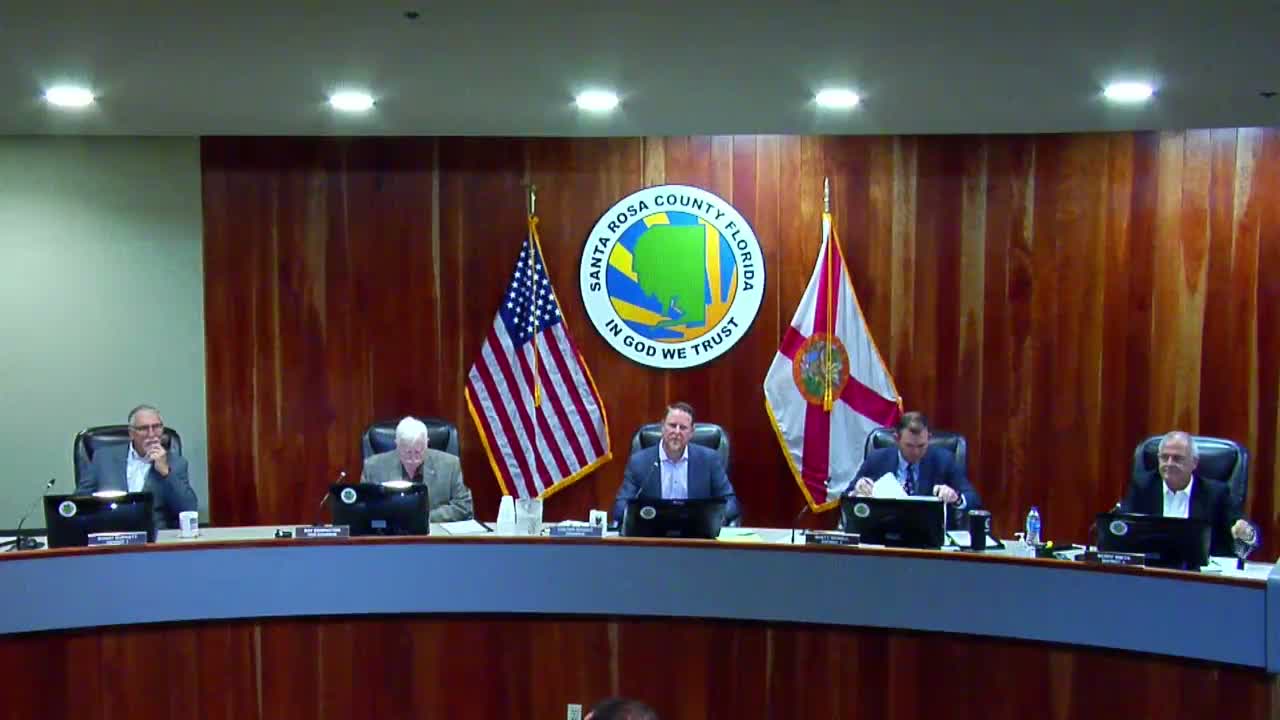
Jason Tripp, a planner with the Santa Rosa County Soil Conservation Department, told the Board of County Commissioners on Jan. 20 that a proposed Legacy Land Protection Program would use conservation easements to preserve farm, ranch and timberland while keeping properties in private ownership.
"It's a voluntary agreement between a land owner and a conservation organization or government agency," Tripp said, describing easements as a way to sell or separate development rights while retaining agricultural uses and ownership. He said the county could use USDA and state ranking systems as models, add a local ranking, and that Blackwater Soil and Water Conservation District would review local scores before sending recommendations to the board for final approval.
Tripp told commissioners the county currently has roughly $2,000,000 set aside that could be used as match funding, that there are about 10,000 acres of applications from county landowners now, and that a conservative estimate to protect a significant share of farmland could be on the order of $50,000,000.
Commissioner Raul framed farmland protection as both an economic and strategic priority, citing university figures he said show Santa Rosa has the state's largest acreage of Class I farmland and that about "21% of Santa Rosa jobs are agricultural related." "This, in my opinion, is what generational thinking looks like," Raul said, and told the board he plans to bring a proposal for further discussion in February.
Tripp listed potential match programs state and federal funders have used, including the USDA Agricultural Conservation Easement Program, FDACS rural‑family lands programs and military-compatible conservation tools such as REPI, and said the county could pair local funds with those grants. He walked the board through appraisal and negotiation steps — including the option of paying a per‑acre rate or paying the cash value difference between full market value and the reduced value after removing development rights — and noted that easements would be recorded permanently with the clerk's office.
No formal motion or vote occurred on Jan. 20. Commissioners asked staff to refine ranking criteria, evaluate appraisal approaches and return with options; Commissioner Raul said he will present a proposal for the board to consider in February.