Get Full Government Meeting Transcripts, Videos, & Alerts Forever!
Get email alerts on the Conservation Funding topic
No spam. Unsubscribe anytime.
Trust for Public Land presents options for voter-funded conservation; staff to poll voters
Summary
The Trust for Public Land presented a feasibility report to the Santa Rosa County Commission recommending a public opinion poll and outlining four finance options (bonding, bond+millage for stewardship, dedicated property-tax millage, and a local-option sales tax) to fund conservation; commissioners signaled support to pursue further research and ballot language work.
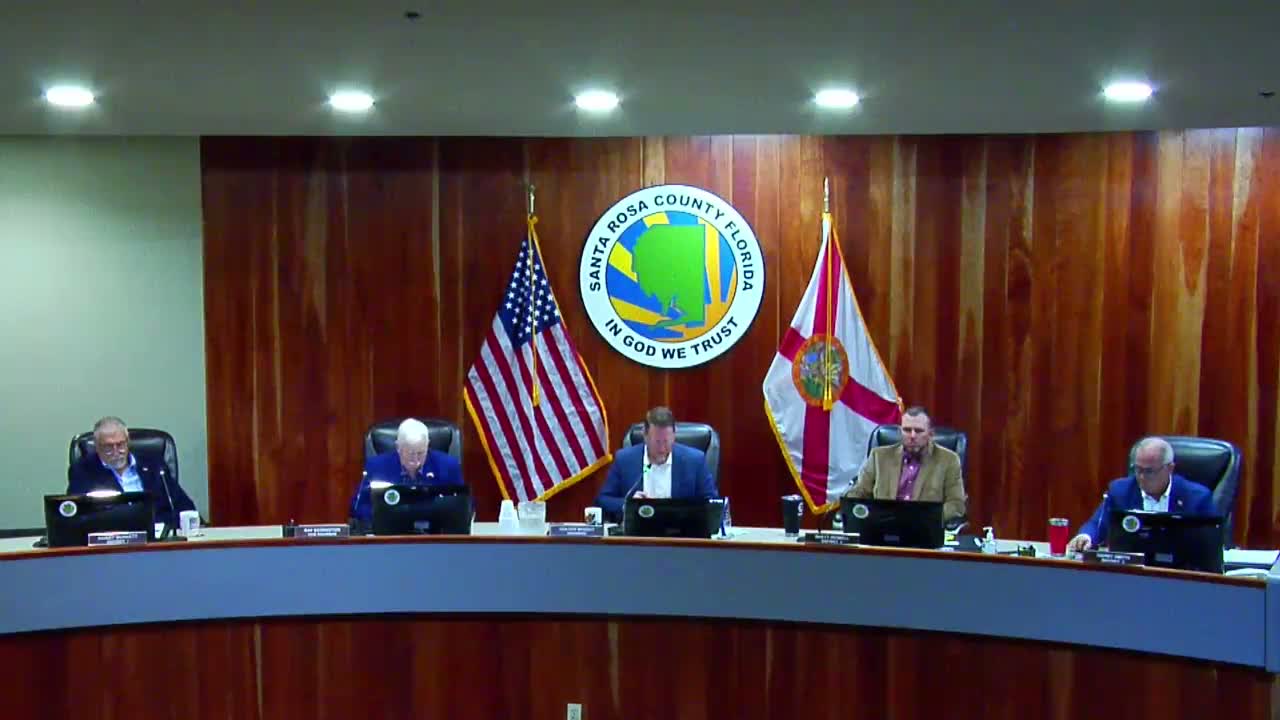
Will Avedger of the national nonprofit Trust for Public Land presented a feasibility study to the Santa Rosa County Commission committee on Dec. 8, outlining finance options for county conservation funding and recommending a public opinion poll as the next step.
Avedger described four approaches the study modeled: a general obligation bond (example scenario: $30 million in bonding), a bond option that includes extra millage for stewardship and maintenance, a straight property-tax dedication (modeled at a 0.15-mill increase), and a local-option infrastructure sales tax. He said a $30 million bond would translate to about $24 per year on the average residential property owner under the study’s assumptions; a 0.15-mill property tax increase would generate roughly $2.4 million annually and cost about $28 per year for the average homeowner; a half-cent local-option sales tax was modeled at about $16 million per year and an estimated $97 per year for a median household.
Avedger said the Trust’s recommended next step is a professionally conducted public-opinion survey to test ballot language, tax tolerance and program priorities; the group proposed to run polling in January and return recommendations in February with the possibility of a March timeline for placing a question on the ballot if the commission chose to proceed.
Commissioners asked for specifics about ballot language and priorities. A member said he wants renewal language to guarantee “a substantial conservation percentage” be included in any renewal question so voters can see measurable outcomes; others emphasized collaboration with the Trust, staff and local partners to craft priorities and determine stewardship funding. The board did not take formal action on placing a question on the ballot at the committee meeting; staff and the Trust were directed to continue engagement and return with poll results and recommended ballot language.
The Trust for Public Land identified the sales-tax option as the most viable in the current fiscal context but framed the polling as the necessary test of voter support. Avedger emphasized the importance of pairing conservation funding with clearly described stewardship and maintenance funding if parcels are acquired.
Next steps: the Trust will conduct polling if the commission wants to proceed; staff said they will coordinate follow-up work and bring recommendations to the commission in February.