Get Full Government Meeting Transcripts, Videos, & Alerts Forever!
Get email alerts on the Reclamation Facility topic
No spam. Unsubscribe anytime.
$64M reclamation plant expansion to add 3.5M gallons/day capacity; county, city cite reuse plans
Summary
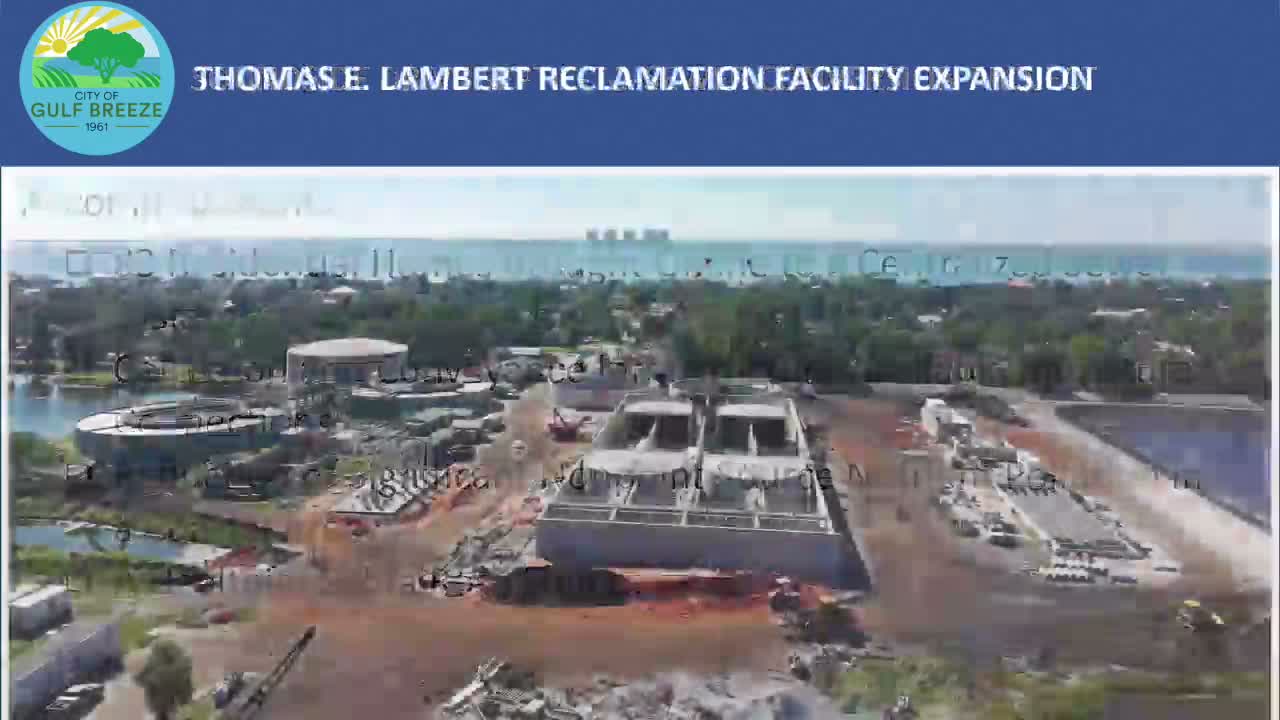
City staff told the Restore Council the Thomas E. Lambert (Tiger Point) reclamation facility expansion is roughly 50% complete, with total project costs presented around $64–66 million, new treatment improvements expected in 2026 and demolition of outdated components in January 2027. The work is designed to add about 3.5 million gallons per day of treatment capacity and support regional reuse.
City of Gulf Breeze staff told the Santa Rosa County Restore Council on Dec. 2 that the Thomas E. Lambert reclamation facility expansion (formerly the Tiger Point plant) is roughly halfway complete and is central to regional reuse and capacity plans.
Samantha Abel described the project as a necessary modernization and capacity expansion: "The project is approximately 50% complete," she said, and staff are projecting final completion in late 2027 with new treatment improvements expected in 2026. Abel told the council the project was presented to support a projected regional growth rate and provide additional reclaimed water for reuse via the so-called "purple pipe" program.
Scope, schedule and cost: Staff reported the new treatment components will add roughly 3.5 million gallons per day of treatment capacity; demolition of outdated components is scheduled for January 2027. The city presented a project construction cost estimate of about $64 million and acknowledged that with engineering and related costs the total approaches $66 million.
Regional implications: Officials said even with the expansion the city would not immediately have capacity to serve every existing septic tank within the service area; they highlighted reuse opportunities and interlocal cooperation (including North Florida Water Management District and county participation) as ways to stretch capacity and reduce land-based disposal needs.
Why it matters: The expansion feeds into three broadly stated county/city priorities — removing effluent from rivers where required by permit, building modern reclamation capacity, and creating reuse systems that reduce demand and limit discharge to sensitive areas. Staff urged council members and commissioners to pursue reuse customers in industrial and commercial sectors to increase reclaimed-water uptake.
Next steps: Staff invited council members to tour the facility and asked for continued collaboration to identify reuse customers and plan operations. The council discussed energy-recovery options briefly; staff said anaerobic digestion for biosolids was not part of the current project scope but left the door open to future conversations.