Lifetime Citizen Portal Access — AI Briefings, Alerts & Unlimited Follows
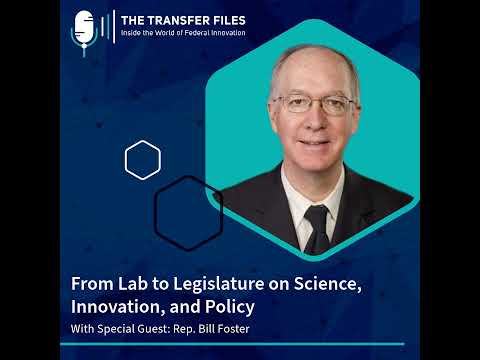
Rep. Bill Foster: National labs and tech-transfer platforms are essential to turning research into startups
Loading...
Summary
Rep. Bill Foster says national laboratories and emerging tech-transfer platforms give researchers access to facilities, data stewardship and practical advice that can prevent avoidable startup failures, strengthen U.S. competitiveness and inform AI policy.
Rep. Bill Foster, a physicist and U.S. representative for Illinois' 11th District, said national laboratories and formal tech-transfer platforms give researchers and early-stage companies the advice and facilities they need to commercialize discoveries and avoid failures. "We had no way to get advice on how to start a business," Foster said, recalling that he and his brother "probably at one point ... counted that there were 5 times when we almost went bankrupt," and that "at least 3 of those were completely avoidable if we had had high quality advice."
Foster, who worked for 25 years at Fermi National Accelerator Laboratory and later co-founded a company that grew to about 1,500 employees and roughly $450,000,000 in annual revenue, described how early access to university and national-lab computing resources helped his firm survive and scale. He said those kinds of institutional supports—access to specialized facilities such as the Advanced Photon Source at Argonne National Laboratory, nanotechnology centers, or shared beam lines—allow companies to pursue feasibility work they could not afford alone.
The episode places that practical value in a policy context. Foster noted that the Federal Laboratory Consortium for Technology Transfer (FLC) recently marked its 50th anniversary and described earlier tech-transfer as a "wild west" where informal arrangements were common. He said the more structured platforms now being established provide the high-quality advice startups need to reduce avoidable business failures and accelerate commercialization.
Foster also discussed the role labs play on AI policy and data stewardship. Drawing on decades of lab research, he said national labs and university partners can help address the "explainability" problem—how to explain automated decisions to affected people. "If someone says, I'm sorry. Your mortgage has been turned down because our neural network says so. How do you explain that? Is that an acceptable answer?" he asked, arguing that long-term research equips policymakers to address such questions.
On international collaboration and talent, Foster urged caution about policies that he said risk pushing skilled PhD graduates away. He recounted losing "one of the best accelerator physicists" he had worked with to immigration rules tied to recognition of same-sex marriage, and said that punitive or xenophobic rhetoric can undercut U.S. competitiveness even as security concerns at some weapons labs remain real.
Foster framed these topics in economic terms, linking lab-industry partnerships to national competitiveness and noting how his physics background informed his work on the Financial Services Committee after the 2008 financial crisis. He also counseled researchers and industry leaders who want to influence policy to meet their members of Congress in-district, where officials can take more time and better appreciate local innovation activity.
The conversation touched on historical anecdotes—Foster said he and his company were early Microsoft customers, calling long-distance to report compiler bugs and receiving floppy disks in return—and on how modern coding assistants and advanced compilers are reshaping how technical work is done. Throughout, Foster argued national labs provide a "flywheel of competence" that helps preserve expertise as technologies cycle through commercial fashions.
The podcast closes with production credits and a note that listeners can find show notes and resource links at federallabs.org and on common podcast platforms.