Get Full Government Meeting Transcripts, Videos, & Alerts Forever!
Get email alerts on the Federal Grants Ready For Life topic
No spam. Unsubscribe anytime.
ACF webinar details Ready for Life grant rules, funding tiers, and application steps
Summary
The Administration for Children and Families’ Office of Family Assistance outlined the Ready for Life NOFO: five-year cooperative agreements with annual budgets of $400,000–$1.25 million, three scope tiers (emerging, small, large), curriculum and domestic-violence requirements, application file/attachment rules, and merit-review scoring.
Seth, a division director in the Administration for Children and Families’ Office of Family Assistance, led a webinar to explain the Ready for Life notice of funding opportunity (NOFO) and what applicants must include in proposals.
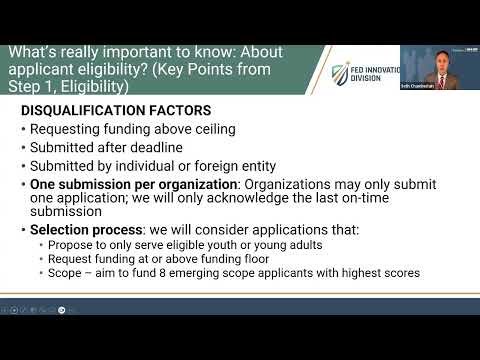
The NOFO funds five‑year project periods made up of five one‑year budget periods, with annual budget amounts ranging from $400,000 to $1,250,000, Seth said. Projects are grouped in three scopes: large scope ($750,000–$1,250,000 per year), small scope ($400,000–$749,999 per year) and an emerging scope (similar dollar range to small but restricted to organizations that have not previously received Healthy Marriage or Responsible Fatherhood funding and that accept capacity‑building assistance).
“This webinar will not cover anything beyond the language that’s in the notice of funding opportunity. We’re not gonna be giving extra hints or secrets about what you should write for your proposals,” Seth said, emphasizing that the presentation explains the NOFO text and review expectations.
Program goals and required services: The NOFO supports marriage and relationship education, education in high schools, and targeted outreach that directly supports recruitment and retention. Grantees must propose a coherent program model (the NOFO encourages one), curriculum‑based workshops of at least 12 hours delivered over more than two sessions across at least two weeks, staffing and training plans, partner agreements, participant recruitment and retention strategies, and systematic data collection.
Seth emphasized statutory safeguards: applicants must address domestic and teen‑dating violence in program design, consult with subject‑matter experts, provide safe opportunities and confidential referral paths for disclosures, and ensure staff training on state child‑abuse reporting requirements.
Participation targets and counting served participants are tied to scope. For example, large‑scope projects must propose serving at least 200 individuals (or 100 couples) per year who complete at least 90% of primary workshop hours; small scope targets are lower (120 individuals or 60 couples). Emerging scope awards have phased lower targets (30 individuals in year 1, growing to the small‑scope minimums by years 4–5). Seth said InForm, the program’s management information system, will be used to record enrollments and attendance.
Budget and permitted uses: The NOFO states funds cannot be used for construction or major renovations, supplanting other funding, or certain support services including legal assistance, health care, mental‑health treatment, child support payments, rent or housing subsidies, and substance‑abuse treatment. Seth also noted that public advertising must be tied to outreach for the program’s authorized activities and cannot be a standalone general campaign.
Application mechanics (Step 2 and Step 3): Applicants must have active SAM.gov and Grants.gov accounts to apply. Damien Frierson, a federal assistance program specialist, said Step 3 requires two uploaded files plus standard forms. File 1 uses the project narrative attachment and must include a table of contents, one‑page project summary, the project narrative, and a line‑item budget and budget narrative. The application page limit for the narrative is 100 pages (standard forms are excluded from that limit).
Damien said the narrative must identify the precise physical location(s) for the project (national programs are not permitted), explain the program model, provide a year‑by‑year approach for the five‑year period, describe organizational capacity and staffing (including a full‑time equivalent project director), and include a logic model, sustainability plan, and privacy protections for personally identifiable information.
Attachments and evaluation funding: Applicants must include required attachments (proof of organizational status, indirect cost agreements if used, third‑party agreements or statements of intent, and partner MOUs or performance‑based agreements). The NOFO allows grantee‑led local evaluations post‑award if approved; OMB guidance cited in the webinar suggested reserving no more than 5% of year‑one funds or $50,000 (whichever is lower) for developing a local evaluation plan.
Selection and scoring (Step 4): Toya Joyner, a federal assistance program specialist, summarized merit review points: Approach (45 points), Organizational capacity (30 points split into capacity to deliver and project management/staffing), Performance measures/CQI/logic model (3 points), and Budget (7 points). “Reviewers will evaluate and score an application based on the documents presented in the application and will not refer to external links,” Joyner said. In addition to scores, OFA will consider geographic distribution, past performance, and whether an application requests funding at or above the funding floor.
Cooperative agreements and post‑award involvement: Seth said awards will be cooperative agreements; OFA will be substantially involved post‑award, assign a family assistance program specialist to provide guidance and review deliverables, and work with recipients during the initial months to finalize cooperative‑agreement terms.
Contacts and next steps: Toya Joyner provided contact details for NOFO questions (her email at ofaatgrantreview.org and Talina Bennett Reed in the Office of Grants Management) and noted Grants.gov and SAM.gov help desks for technical support. Seth closed by pointing applicants to the NOFO appendices (the target shell is included in the NOFO) and encouraged applicants to begin drafting proposals.
The NOFO contains many specific technical and submission rules; applicants should rely on the NOFO text, follow the specified attachment and target templates, and ensure required MOUs, third‑party agreements, and documentation are included in their submissions. The webinar ended with an invitation to apply and a reminder that submitted continuations and post‑award funding are contingent on available appropriations and satisfactory performance.