Lifetime Citizen Portal Access — AI Briefings, Alerts & Unlimited Follows
ACF details FORGE Fatherhood NOFO: up to $1.25 million per year for five‑year responsible‑fatherhood projects
Loading...
Summary
The Administration for Children and Families outlined a FORGE Fatherhood NOFO in a webinar, offering five‑year cooperative agreements with a $1,250,000 annual ceiling, three required program activities (parenting, healthy marriage, economic stability), participant‑target minimums by scope, performance reporting requirements, and application and merit‑review procedures.
The Administration for Children and Families (ACF) on a webinar detailed the FORGE Fatherhood Notice of Funding Opportunity (NOFO), which will fund five‑year cooperative agreements that support responsible‑fatherhood programs nationwide. "We're excited to provide you an overview of 1 of our new funding opportunities, FORGE Fatherhood," said Taffy Compain, Branch Chief, Federal Innovation Division, Family and Economic Stability, Demonstration, and Innovation Division, Office of Family Assistance, ACF.
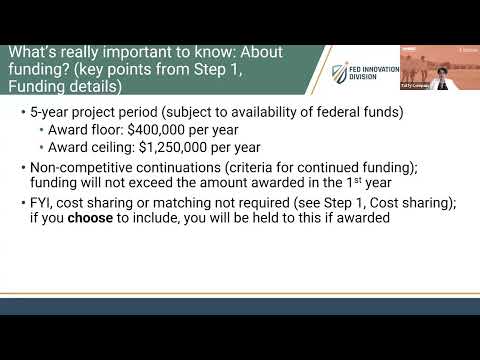
The NOFO authorizes projects under the statutory Responsible Fatherhood authority (42 U.S.C. 603(a)(2)) and sets aside $75 million specifically for responsible‑fatherhood activities as part of the fifth five‑year cohort. Awards are for a five‑year project period with annual budget periods; the award ceiling is $1,250,000 per year. Continuations for years two through five are noncompetitive and conditioned on fund availability, satisfactory progress on performance benchmarks, and an agency determination that continued funding is in the federal interest.
Funded projects must implement activities drawn from each of three statutory categories: (1) promoting responsible parenting, (2) promoting or sustaining healthy marriage, and (3) fostering economic stability. Projects are not required to adopt every listed activity within each category but must select allowable activities under each category. Primary workshops must provide at least 24 hours of curriculum, including at least eight hours devoted to the healthy‑marriage component; curricula must be evidence‑informed, skill‑based, and delivered in multiple sessions over at least two weeks.
Eligibility is limited to public entities and vetted nonprofit organizations. The NOFO lists eligible applicants such as state, county, city and township governments, public/state‑controlled institutions of higher education, Native American tribal governments and tribal organizations, and faith‑based and community organizations that meet requirements. Individuals, sole proprietorships, foreign entities and for‑profit entities (including for‑profit colleges) are ineligible.
Applicants must choose a scope that matches organizational capacity. ACF described three scopes: large, small, and emerging (the latter intended for organizations not previously funded under HMRF and open to capacity building). ACF set minimum annual participant targets tied to funding level: large‑scope applicants requesting roughly $750,000–$1,250,000 must plan to serve at least 160 workshop completers per year; small‑scope applicants (roughly $400,000–$749,999 or prior HMRF recipients) must plan for at least 100 completers per year; emerging‑scope applicants follow a graduated target schedule (25 in year one, 50 in year two, 75 in year three, and 100 in years four and five). A father is counted as served if he receives at least 90% of the primary workshops.
Projects must include intensive case management (ACF expects on average eight individual service contacts per client), recruitment and retention strategies, and formal, performance‑based partnerships with at least two employment‑focused organizations (for example, American Job Centers or workforce programs under the Workforce Innovation and Opportunity Act). ACF also encouraged collaborations with housing and child‑support agencies for referrals, but the NOFO prohibits use of grant funds for subsidized housing, housing vouchers, child support payments, legal assistance, or treatment services such as substance‑abuse treatment.
Grantees must collect standardized performance data in the NFORM system, develop an initial continuous quality improvement (CQI) plan within three months of award, and participate when feasible in federally led evaluations. Grants will be issued as cooperative agreements, meaning ACF (OFA) will be substantially involved through assignment of a Family Assistance Program Specialist, oversight of deliverables, guidance on scope, and technical assistance.
ACF outlined application formatting and submission rules: applicants submit two files plus standard forms (which do not count toward the 100‑page limit), include a clear project narrative (geographic location, need, objectives, outcomes), an approach with concrete implementation plans for each program year, staffing plans, signed MOUs, budget and budget narrative, and required attachments. Applicants must maintain a SAM.gov registration (UEI) and an active Grants.gov account. The NOFO allows ACF to fund applications in whole or in part or at an amount lower than requested.
Tanya Howe, Family Assistance Program Specialist, and John Allen, Family Assistance Program Specialist, walked applicants through step‑by‑step application components and merit‑review criteria, respectively. For questions the webinar listed contacts including Tanya Howe (OFA) and Talina Bennett Reed (Office of Grant Management). The webinar closed with a reminder that awarded projects will be expected to uphold program objectives and contribute to improved outcomes for fathers, couples, families and children.
Next steps for applicants are to review the full NOFO, assemble required documentation and registrations, and follow the submission instructions on Grants.gov and SAM.gov. The NOFO also specifies planning‑period timelines and pilot windows tied to scope and readiness criteria.