Get Full Government Meeting Transcripts, Videos, & Alerts Forever!
Get email alerts on the Ttcw Nofo topic
No spam. Unsubscribe anytime.
ACF webinar walks tribes through Tribal TANF and Child Welfare coordination NOFO
Summary
The Administration for Children and Families held a webinar explaining the Tribal TANF and Child Welfare (TTCW) NOFO, outlining program purpose, eligible applicants, allowable uses of funds, required data tools, and cooperative-agreement oversight.
The Administration for Children and Families’ Office of Family Assistance held a webinar to explain the Tribal TANF and Child Welfare (TTCW) notice of funding opportunity and what tribes or Alaska Native nonprofits must provide to apply.
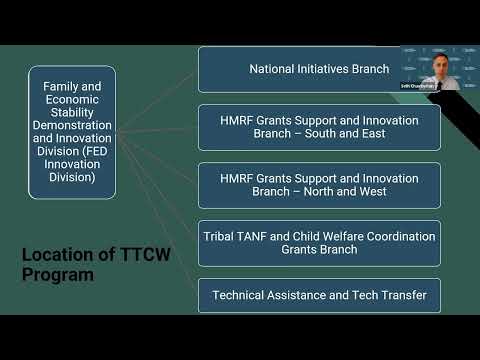
Seth Chamberlain, division director in the Office of Family Assistance’s demonstration and innovation division, said TTCW is a demonstration program authorized in 2006 and reauthorized in 2010 that funds projects to better coordinate tribal TANF and child welfare services. "The overall purpose of these grants is to fund projects that coordinate existing services and other relevant programs," he said.
Delia Smith, a federal project specialist, and Cheyenne Stone, another federal project specialist, outlined the program’s three statutory purposes: improve case management, provide supportive services for children in or exiting care, and provide preventive services for families at risk of child abuse or neglect. The presenters repeatedly stressed projects should demonstrate improved coordination and produce lessons to share across tribal TANF and child welfare systems.
The webinar listed allowable activities under TTCW: updating referral and joint case-management procedures, cross-training tribal TANF and child welfare staff, formalizing partner roles (for example through MOUs), carrying out human-centered design to reduce access barriers, providing limited tangible supports tied to sustainable plans, and developing tools to assess child safety and risk. Presenters emphasized that some activities may require legal review and data‑sharing agreements to protect personal information.
Award structure and oversight: presenters said TTCW awards are cooperative agreements requiring substantial ACF involvement, including an assigned Family Assistance Program Specialist who will provide guidance, review project materials and collaborate after award negotiations. The webinar also covered program support: ACF will provide technical-assistance contractors and expects awardees to engage in both in-person site visits and virtual activities.
Reporting, tools and meetings: awardees must complete the Collaboration Assessment Tool (CAT) and submit a logic model and annual progress reports. The CAT assesses eight collaboration areas and requires narrative justification for scores. Awardees are expected to attend annual TTCW meetings (noted as being held in Washington, D.C., or elsewhere) and design projects to be sustainable beyond the grant period.
Eligibility and continuations: presenters described eligible applicants as Indian tribes, Alaska Native regional nonprofits administering tribal TANF on the NOFO publication date, or consortia of two or more tribes administering tribal TANF on behalf of members. They said noncompetitive continuations are possible if funds are available, performance benchmarks are met, and continued funding is in the federal interest.
Conflicting funding figures noted in the webinar: S1 stated that TTCW grants are five-year awards and that the award floor and ceiling is "$215,000 per year," but later in the same section also said "the award must be $250,000 per year," creating an inconsistency in the webinar remarks. The article reports both statements as presented during the session; applicants should rely on the NOFO text for the authoritative award amount.
What applicants must demonstrate: presenters said applications should describe current tribal TANF and child-welfare practices, clearly identify problems to be addressed, explain how proposed activities will achieve objectives, and include measurable outputs. Delia Smith reiterated that reviewers will score applications only on materials submitted with the application package and that applicants should not rely on external links for scoring evidence.
The webinar closed with contact names for questions about the NOFO and application process and an encouragement to apply. Presenters said they look forward to reviewing applications and to award projects that strengthen coordination for tribal families.