Lifetime Citizen Portal Access — AI Briefings, Alerts & Unlimited Follows
Federal evaluation: CWCC projects used broad partnerships and planned to sustain nearly all strategies
Loading...
Summary
A federal cross‑site process evaluation found Child Welfare Community Collaborations to Strengthen and Preserve Families (CWCC) grantees engaged diverse partners, used data to target services, and reported plans to sustain 99% of implemented strategies; full briefs and methods are available from the Children’s Bureau and ACF.
The presenter summarized a U.S. Department of Health and Human Services evaluation of the Child Welfare Community Collaborations to Strengthen and Preserve Families Initiative (CWCC), saying the program “was funded by the Children's Bureau,” part of the Administration for Children and Families (ACF). The presenter described a cross‑site process evaluation conducted by AppGlobal and Child Trends for ACF’s Office of Planning, Research, and Evaluation (OPRE).
The evaluation relied on site visits, “405 in‑depth interviews and 1,720 collaboration surveys,” and document review to assess how grantees built collaboratives to prevent child abuse and neglect. The presenter said the analysis found CWCC projects “achieved several key successes in advancing the initiative's goals,” notably broad partner engagement—grantees partnered with about “20 organizations on average”—and implementation of multi‑level prevention strategies.
According to the presenter, partner types included community‑serving organizations (behavioral, physical and mental health specialists), concrete service providers such as food and housing programs, community‑based nonprofits, and public agencies including legal and social service offices; philanthropic, business and educational organizations also participated. All 13 CWCC projects, the presenter said, used data to identify communities and families in need and to guide service decisions, employing child maltreatment data, demographic information, needs‑assessment surveys, referral and participation data, and measures of fidelity and satisfaction.
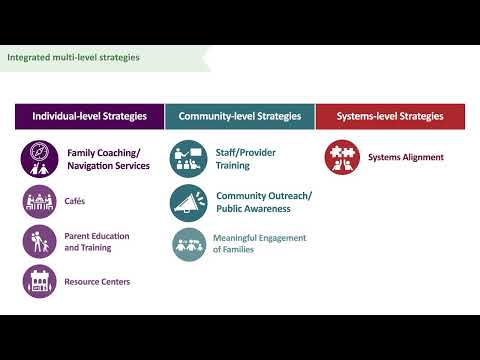
The presenter described three tiers of strategies observed across projects: individual‑level supports (for example, family coaching and navigation), community‑level activities (staff and provider trainings, outreach), and systems‑level approaches to improve coordination and data sharing. On sustainability, the presenter stated that interviewees plan to sustain strategies in some capacity and reported plans to sustain “99% of the strategies implemented in some capacity.”
The evaluation team distilled six lessons for communities seeking to replicate collaborative prevention work: build trusting relationships with partners and families; ensure partners have dedicated resources; use data to drive decisions and sustainability planning; engage people with relevant lived experience as equal partners; establish clear communication and coordination mechanisms; and adapt services to specific family needs. The presenter directed listeners to the evaluation’s executive summary and topic briefs (implementation strategies, partnerships, data use, sustainability) and a projects‑at‑a‑glance brief for details on individual grantees.
The evaluation and supporting briefs are available through the Children’s Bureau and ACF; the presenter provided a link in the video description for the full series of cross‑site evaluation products.