Get Full Government Meeting Transcripts, Videos, & Alerts Forever!
Get email alerts on the Home Visiting Measurement topic
No spam. Unsubscribe anytime.
New Supers HV self‑report measure documents reflective supervision in home visiting
Summary
A newly developed supervisor self‑report tool, Supers HV, aims to fill gaps in evidence about reflective supervision in home visiting. The 37‑item measure was tested with 502 supervisors, is estimated to take 10–15 minutes, and will be available from OPRE with supporting materials.
A team developing tools to support the home‑visiting workforce introduced Supers HV, a supervisor self‑report measure designed to document reflective supervision practices and support research and practice improvements.
The measure was created because, the presenter said, there is “limited understanding of how [reflective supervision] is practiced and limited evidence of its effectiveness.” To address that gap, the team designed Supers HV to assess a single supervisory session and the specific behaviors supervisors use, aiming to reduce recall bias and enable links between practices and outcomes.
In development, the project followed three phases: concept mapping and definition; item generation with interpretation meetings, cognitive interviews and a pretest; and large‑scale psychometric testing. The presenter reported a large‑scale survey of 502 supervisors to evaluate item performance, factor structure, internal consistency, validity, reliability, feasibility and acceptability. A subgroup completed repeated measures testing and later participated in focus groups to clarify preliminary findings.
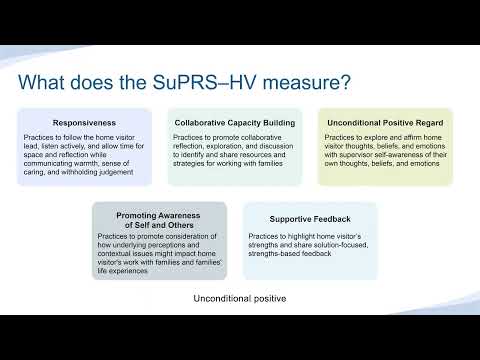
Supers HV contains 37 items spread across five subscales that the presenter named as responsiveness; collaborative capacity building; unconditional positive regard; promoting awareness of self and others; and supportive feedback. The measure also includes an 11‑item checklist of topics discussed during a supervision session (for example: impacts on the child, caregiver–child interactions, family strengths, setting and maintaining boundaries, program requirements and community characteristics).
The team designed Supers HV for supervisors, consultants or managers who provide direct one‑on‑one reflective supervision across a range of home‑visiting models. The presenter recommended supervisors complete the measure as soon as possible after a session; the instrument is estimated to take about 10–15 minutes to complete.
The presenter summarized user feedback collected during testing: “It was very thorough, but also helped me identify or think about areas that I may work on using more during supervision,” a participating supervisor said, and another said the questions “really allowed me to reflect on what I did or didn’t touch on.” The presenter said supervisors found the items helpful for planning and reflecting on future sessions.
For researchers and programs, the presenter said Supers HV can document and describe reflective supervision practices, compare practices across settings and samples, and examine associations with program and family outcomes. For practice, the measure could serve as a menu of practices to prepare for and document sessions or to guide reflective improvement efforts.
Supporting materials mentioned include a technical manual with formatting guidance for electronic surveys and mobile optimization, a one‑page fact sheet, and two journal manuscripts describing methods and results that are under development. A PDF of Supers HV will be made available for free on the Office of Planning, Research and Evaluation (OPRE) website. The presenter acknowledged OPRE funding and federal staff who provided guidance.
The presenter closed by thanking work‑group members and partners for their contributions and provided three contact names for questions about the measure: Nicole Denmark, Lisonbee West and Mariel Spar.