Hernando commissioners set March workshop after wide debate on license‑plate readers
Loading...
Summary
After hours of public comment and commissioner debate about privacy and public safety, the board scheduled a March 10 workshop to review a draft interlocal agreement governing automated license‑plate readers and data use by the sheriff's office.
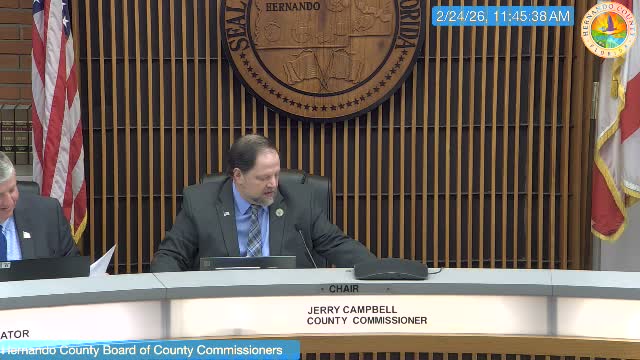
The Hernando County Board of County Commissioners scheduled a public workshop for March 10 to give residents a full opportunity to review and weigh in on a draft interlocal agreement governing automated license‑plate reader (ALPR) technology used by law enforcement.
Commissioner Christopher Hawkins, who advanced the draft MOU, said the document was intended to set operational limits and safeguards. "It's a discussion," Hawkins told the board, stressing the draft is meant to define data retention, access and permitted uses and to be debated publicly before any formal decision.
Why it matters: The county faces competing priorities — residents pressing for strict limits on surveillance and data retention, and law‑enforcement proponents who say ALPRs help recover stolen cars, locate missing persons and solve serious crimes. Several residents urged caution; other commissioners said denying the sheriff the tool used widely elsewhere could put Hernando at a tactical disadvantage.
The draft MOU circulated to the board limits stored ALPR data to still images searchable by plate number or vehicle characteristics, restricts access to "hot files" tied to active investigations, and directs the sheriff's office to disconnect systems if a competent court finds their use unlawful. Sheriff Fernando Penascher told commissioners he and his office reviewed the MOU and "have no issues with it" and believe the draft addresses legal concerns.
Public comment at the meeting was extensive. Residents asked how long images would be retained, who — including any private vendors — would be permitted to store or access data, and whether third‑party audits would verify compliance. Gary Mazutt called for the matter to be delayed for fuller public education; Christopher Anger and others said the community needed earlier notice of agenda changes and more time to prepare.
Commissioner Champion, while sympathetic to civil liberties concerns, urged a balanced approach: "If you give up your rights, you'll never get them back," he said, arguing safeguards matter but so does public safety. Several commissioners urged the state to clarify uniform rules for ALPRs so counties are not operating under inconsistent standards.
Next steps: Administrator Jeff Rogers said staff had tentatively scheduled a community workshop for March 10 at 5 p.m., and the board agreed to that date. The workshop will include presentations from the sheriff's office, county staff and a representative from the vendor (if available), followed by public comment and Q&A. The board expressly framed the workshop as an educational forum intended to inform any future policy or ordinance action.
The discussion leaves the county with follow‑up items: clarifying retention timelines, confirming vendor obligations for data security, defining third‑party audit rights, and compiling model language for public review before any final vote.