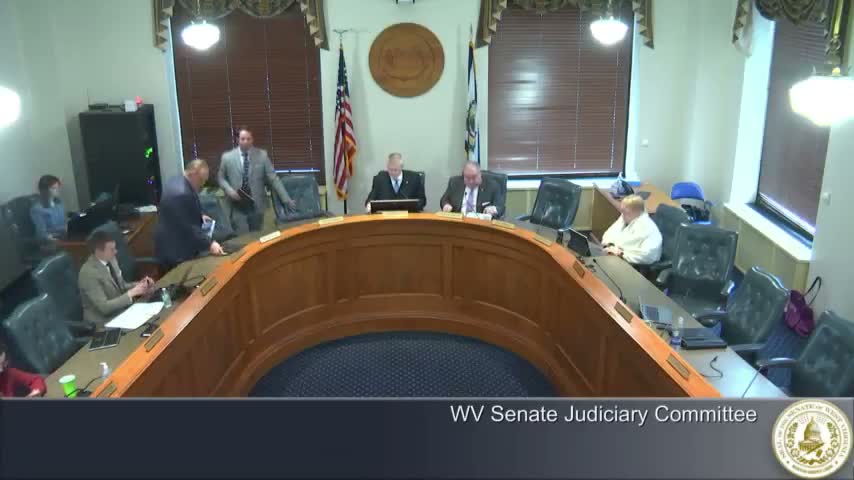
Senate panel sets SB 986 for subcommittee after lawmakers debate new 'child torture' offense
Loading...
Summary
A Senate committee debated a bill that would create a new crime of "child torture," clarifying that reasonable corporal punishment would not be treated as abuse, and referred the measure to subcommittee after prosecutors and senators raised definitional and double‑jeopardy concerns.
Committee counsel told a West Virginia Senate committee that the committee substitute for Senate Bill 986 would both clarify that "reasonable corporal punishment, including spanking, does not constitute abuse" in abuse-and-neglect proceedings and create a new criminal offense called child torture.
The proposal defines child torture as "the intentional or knowing course of conduct against a child that involves extreme cruelty resulting in physical pain, severe emotional distress, or substantial risk of serious bodily injury by a parent, custodian, or person of trust for the child," and sets two penalty tiers: child torture and aggravated child torture. Counsel said aggravated torture applies where aggravating factors — including intent to terrorize, sadistic gratification, bodily injury, or use of a deadly weapon — are present.
Senators pressed counsel for drafting clarity. One senator asked whether references in subparagraphs to "emotional distress" should read "severe emotional distress," and counsel replied that the text was written so the conduct must result in severe emotional distress while the actor's intent need not be to cause a clinically defined condition.
Prosecutor Kinzer, appearing by phone, said many prosecutors support criminalizing conduct that currently falls outside the scope of child‑abuse criminal statutes, but urged more precise drafting to avoid double‑jeopardy or overlap with existing child‑abuse and neglect provisions. "There are situations that I see as a prosecutor ... that's gotta be criminal. That is criminal conduct," Kinzer said, while also warning the committee that the bill "may be trying to do maybe too much" as drafted.
Kinzer gave a factual example to illustrate the gap: parents who locked a child in a small, padlocked space for hours with no facilities and only a mat on the floor. He said that conduct produced neither clear serious bodily injury nor immediate risk of death, yet prosecutors considered it criminal in moral terms. "How is that not criminal?" he asked the committee, urging careful statutory design.
Lawmakers also asked about the statute's scope. Counsel said the offense would apply to parents, guardians, custodians or persons "in a position of trust," but that liability requires intentional and knowing conduct; a teacher who sees bullying would not ordinarily be criminally liable unless the teacher intentionally and knowingly tortured the child.
After extended questioning and concerns about precise definitions and defensive issues raised by members and the prosecutor, the chair said the committee would place SB 986 into subcommittee to refine the language with prosecutors. The subcommittee members named were the senator from Brook (chair), and the senators from Marion, Jefferson, Greenbrier and Ohio.
Next steps: SB 986 will be revised in subcommittee before returning to the committee for further consideration.