Get Full Government Meeting Transcripts, Videos, & Alerts Forever!
Get email alerts on the Public Safety Police topic
No spam. Unsubscribe anytime.
Police Chief Colon says arrests rose as traffic enforcement increased; department plans new beat, five hires and HQ needs assessment
Summary
Police Chief Colon told the Smart Growth Commission that stepped-up traffic enforcement and DEA task-force work led to more arrests; he outlined plans to add a west-side beat, hire five officers, upgrade encrypted radios and complete a needs assessment for a new police headquarters.
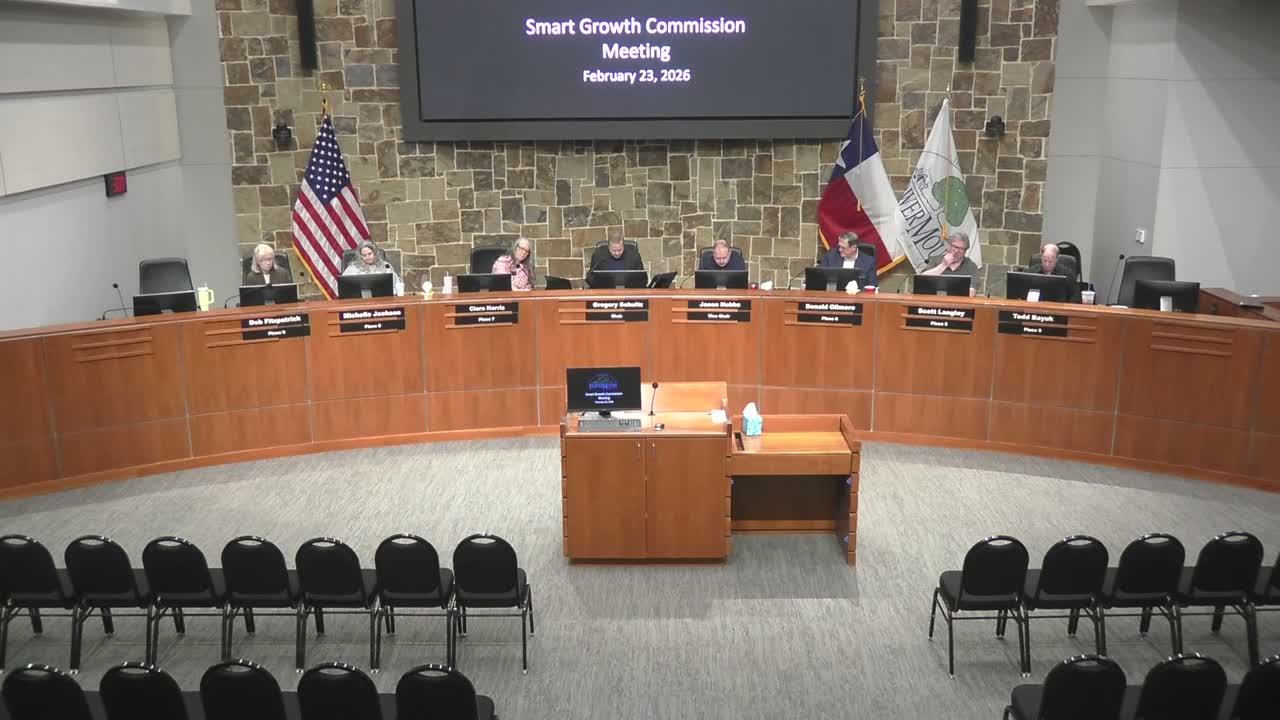
Police Chief Colon told the Flower Mound Smart Growth Commission on the evening the commission met that the police department saw more arrests after increasing traffic stops and leveraging federal task‑force resources.
Colon, presenting the department's 2025 annual report, said the department organizes its work into four divisions — uniform services, criminal investigations, a mental‑health unit and narcotics — and emphasized the support roles civilian staff provide. "When the badge walks through the door, all these people are walking through the door," he said.
The chief said Part 1 crimes were down from 2024 to 2025 in most categories but that thefts, including shoplifting at big‑box stores, remain a driver of overall crime numbers. He highlighted response‑time goals: priority 1 responses under five minutes and priority 2 around six and a half minutes. Where response times lagged in certain western beats, the department experimented with overtime overlap shifts and is planning to create an additional beat west of the railroad line. "We're gonna have to hire five officers," he said, to staff a 24‑hour beat.
Colon attributed the recent rise in arrests in part to increased traffic enforcement — "when you do that, you run across more people with warrants, more people with drugs, more people with guns" — and described work with a DEA task force that he said helped produce a large investigation involving fentanyl discoveries at a high school and arrests as the joint operation extended beyond local borders.
He reviewed community programs, school resource officers and animal services, and noted new equipment and training plans: encrypted radios to prevent third‑party tracking of police channels, a radio system upgrade to add channel capacity and redundancy, negotiated virtual‑reality taser training, and procurement of motorcycles to focus traffic enforcement.
On facilities, Colon said the town purchased the remaining Hilliard property for a combined police and fire station site; a police needs assessment is underway but he said a new headquarters would not likely open for about five years even at full speed.
The presentation drew questions from commissioners about interagency coordination after a neighborhood incident, the apparent increase in aggravated‑assault figures (which Colon attributed largely to expanded offense categorization and domestic‑violence cases), and community reaction to stepped‑up enforcement. The chief said the department balances warnings and citations based on officer judgment and that enforcement changes aim to reduce injuries and crashes.
The commission received the report and thanked the chief for the update and his staff for the department's work.