Get Full Government Meeting Transcripts, Videos, & Alerts Forever!
Get email alerts on the Tree Ordinance Review topic
No spam. Unsubscribe anytime.
Flower Mound ECC advances review of tree-protection measures, weighs lowering post-oak threshold amid reports of elevated tree losses
Summary
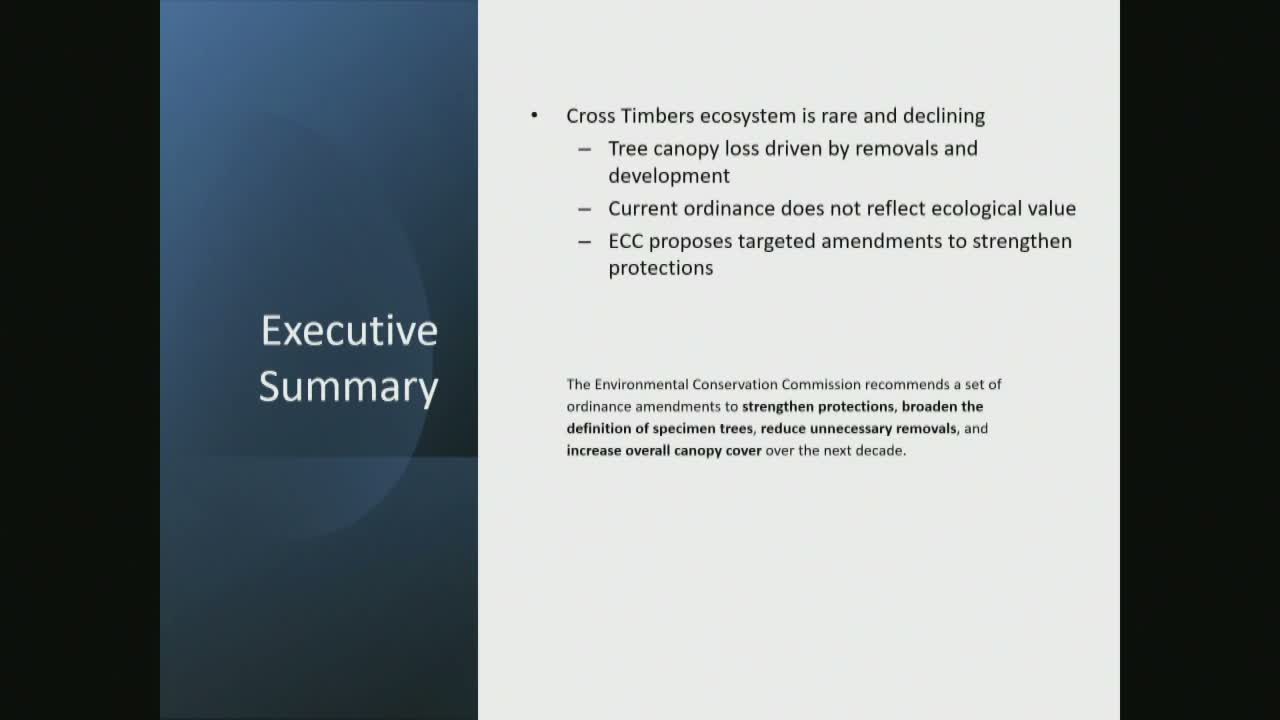
Commissioners discussed a package of potential ordinance changes to protect the town's tree canopy, including lowering the post-oak specimen threshold (discussed at 22 to 18 inches), revising credit schedules and strengthening construction-period protections. Staff will run more data and return to a work session before recommending code changes.
Commission members spent a substantial portion of the Feb. 3 meeting reviewing possible amendments to the town's tree ordinance intended to preserve post oaks and improve long-term canopy resilience.
An ECC presenter summarized a list of potential changes: lowering the post-oak specimen threshold from 22 to 18 inches (staff have run some sample models at 19 inches), considering narrower adjustments for other species, revisiting the mitigation-credit schedule that incentivizes developers to preserve older trees, and improving construction-period protections and inspections to reduce inadvertent root damage.
Staff noted the difficulty of balancing incentives and outcomes: credits can reward preservation but changing the schedule or thresholds would alter mitigation requirements for current and future projects. Commissioners repeatedly requested more project-level data before advancing code amendments. One member asked staff to model impacts for the 18-inch threshold across sample projects; staff agreed to provide those analyses and to bring the topic to a work session in March or April depending on scheduling.
The commission also discussed reports from residents complaining of accelerated tree mortality on private properties (one resident described losses of "5 to 50" trees on affected properties). Jake, the town's urban forester, and staff agreed to reach out to regional extension resources, local arborists and neighboring cities to determine whether the pattern is localized and to advise on next steps.
Why it matters: Post oaks grow slowly and are difficult to replace; lowering specimen thresholds or altering credit schedules would change mitigation expectations for developers and homeowners and could preserve more large trees if adopted. Commission members emphasized caution, data-driven analysis and a staged approach before bringing any ordinance amendments to Planning & Zoning or Town Council.
Next steps: Staff to run additional credit/threshold models (including an 18-inch post-oak scenario), propose a focused work session, and provide sample-project impact reports for ECC review prior to formal ordinance recommendations.