MIT Lincoln Laboratory showcases RF systems test facility's full prototyping capabilities
Loading...
Summary
Dr. Alan Fenn of MIT Lincoln Laboratory gave a virtual tour of the RF Systems Test Facility, describing six anechoic chambers, near-field scanners and a compact range that cover frequencies from a few hundred megahertz to about 100 gigahertz, and explained how users (government, industry, universities and startups) can access testing and prototyping services.
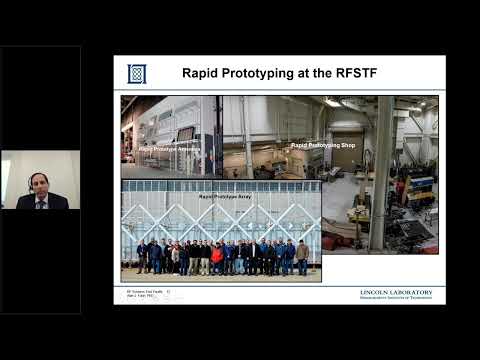
Dr. Alan Fenn, senior staff in the RF Technology Group at MIT Lincoln Laboratory, described the laboratory's RF Systems Test Facility and its role in rapid prototyping, systems integration and technology transfer.
"We have six anechoic chambers," Fenn said, "a low-frequency tapered chamber, a millimeter-wave chamber to go up to 100 gigahertz, a very general-purpose system test chamber, a compact range and near-field scanner facilities." He said the facility is co-located with Lincoln Laboratory's flight test facility on Hanscom Air Force Base, allowing teams to test hardware indoors and then move it directly to aircraft for integration and flight trials.
The facility performs a wide range of antenna and electromagnetic measurements, including radiation-pattern and gain testing, input-impedance and mutual-coupling characterization for phased arrays, electromagnetic-compatibility and interference tests, and radar cross-section measurements. Fenn said chambers operate across broad frequency bands and that the compact range simulates far-field conditions in a quiet zone roughly 12 feet on a side.
Fenn described the system test chamber as a flexible environment for large-project checkout: it can accommodate vehicles and UAVs (12-foot access doors and overhead cranes), handle objects up to about 2,000 pounds, and support high-power tests including vacuum bell-jar setups to simulate high-altitude operation. He noted the laboratory uses near-field scanning with probe systems and Fourier transforms to validate far-field performance and cited an example of a 5,000-element phased array that is tested and calibrated in the large near-field scanner.
On who uses the facility, Fenn said most projects are government-funded (Air Force, Navy, Army) but the lab also collaborates with industry, universities and startups when appropriate. "We had 30 high school students in last week," he said, describing an annual two-week program where students build and test small radar systems and tour the test facility. Fenn said the lab can work under nondisclosure agreements and sometimes engages in technology transfer that leads to civilian startup applications; he cited a ground-penetrating radar that moved from military development to a civilian use case.
When asked about scheduling and availability, Fenn said planning matters: some projects occupy chambers for months, the longest he recalled being about nine months for an X-band phased-array radar, while more typical stays range from a week or two to several months depending on project scope and priority. He advised prospective users to allow one to two months lead time, and ideally three to four months for complex projects, while noting the facility will prioritize urgent, high-priority measurements when required.
Fenn declined to provide a standard daily rate, saying pricing "highly depends" on the personnel support and scope required; he added that fees are typically assessed by day rather than by hour because setup and measurement work generally require full-day engagement. He encouraged teams to contact the facility for scoping and formal test agreements and provided the facility email (rfstf@ll.mit.edu) and a five-minute virtual tour link in the presentation chat.
Fenn also addressed classified work and security: the lab can support tests at required security levels, including securing the compact range as a safe/skiff and coordinating with customer security offices and the base to control access. "We don't allow foreign nationals into the facility," he said, and added that unclassified visits (for example, high school tours) are possible for U.S. citizens with an invitation.
The session ended with contact information and resources for teams interested in using the RF Systems Test Facility for prototyping, integration and measurement services.