Lifetime Citizen Portal Access — AI Briefings, Alerts & Unlimited Follows
MIT Lincoln Laboratory's STRIVE Center showcases immersive testbed for rehabilitation, training and sensor validation
Loading...
Summary
Dr. Brian Baum, research director of the STRIVE Center at MIT Lincoln Laboratory, outlined the center's 4,000-square-foot immersive facility in Billerica, Massachusetts, its CAREN/Cairn dome and motion platform, a published study on detecting mild TBI, and collaboration options including a test agreement he estimated at about $10,000 per day.
Dr. Brian Baum, research director of the STRIVE Center in the Human Health and Performance Systems group at MIT Lincoln Laboratory, described the center's immersive testbed and how it's used to validate sensors, develop training and translate laboratory findings into clinical and operational settings.
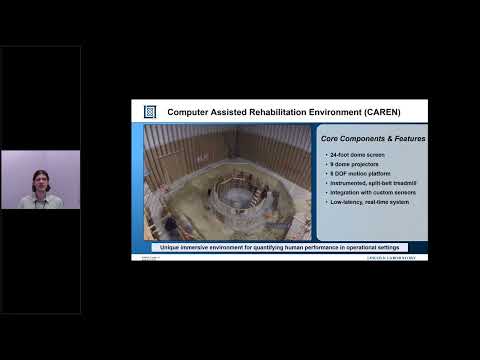
The STRIVE Center is a roughly 4,000-square-foot facility in Billerica, Massachusetts, built around a 24-foot immersive dome and a 6-degree-of-freedom motion platform that supports a split-belt, instrumented treadmill, Baum said. The dome projects 360-degree visual environments with eight warped and blended projectors and integrates synchronized motion capture, electromyography and other sensors to collect comprehensive kinematic, kinetic and physiological data in real time.
"We like to think of the CAREN system as a flight simulator for dismounted activities," Baum said, describing the platform's ability to translate terrain and perturbations into realistic motion and to run the treadmill in self-paced or fixed-speed modes. He noted the treadmill can reach speeds up to 6 meters per second and the testbed uses a 16-channel electromyography system and both marker-based and markerless motion capture synchronized to video.
Baum presented examples of how the environment is used. Biofeedback and multitasking scenarios can adapt difficulty dynamically; a land-navigation simulation covered about 25 square kilometers of modeled terrain; and LiDAR point clouds and the Unity 3D engine let researchers map or reproduce specific operational environments. Those features, he said, let teams generate high-fidelity, repeatable scenarios for rapid iteration, validation and training.
On clinical validation, Baum described a study using perturbation tests to measure dynamic balance in people with mild traumatic brain injury (TBI). "We were able to discriminate mild traumatic brain injury deficits better than the current clinical tests allow," he said, and reported that two of the center's tests achieved "perfect discrimination." He attributed the improved detection to the combination of synchronized motion capture, muscle activity (EMG) and platform perturbations that reveal deficits not seen in standard clinical exams.
Baum also explained how outside researchers and companies can work with STRIVE. Options include collaborative R&D, SBIR/STTR-style partnerships, R&D subcontracts and test agreements that allow private-sector organizations to use the facility for measurement and validation. "The first step is contact me," he said, describing an initial scoping conversation to tailor protocols to end-user needs and identify the most sensitive biomarkers or measures for a given application.
On costs, Baum said a simple non-research test agreement to rent the system and support data collection would run "about $10k per day," while full research projects would be priced according to protocol complexity, staffing and support needs. He noted government research contracts and subcontracting mechanisms are also available depending on project goals.
Dr. Joe Dorenzo, deputy regional coordinator for the Northeast Region of the Federal Laboratory Consortium for Technology Transfer (FLC), opened and moderated the webinar and invited attendees to follow up by chat or email. Baum closed by encouraging collaborations and referencing the STRIVE Center's external-facing website for further information.
The webinar concluded with a brief Q&A on scaling outcomes to clinics and operational environments, access procedures, and contracting options; Baum reiterated that protocol design with end users is key to translating testbed results into deployable technologies and clinical measures.