Get Full Government Meeting Transcripts, Videos, & Alerts Forever!
Get email alerts on the Land Use Zoning topic
No spam. Unsubscribe anytime.
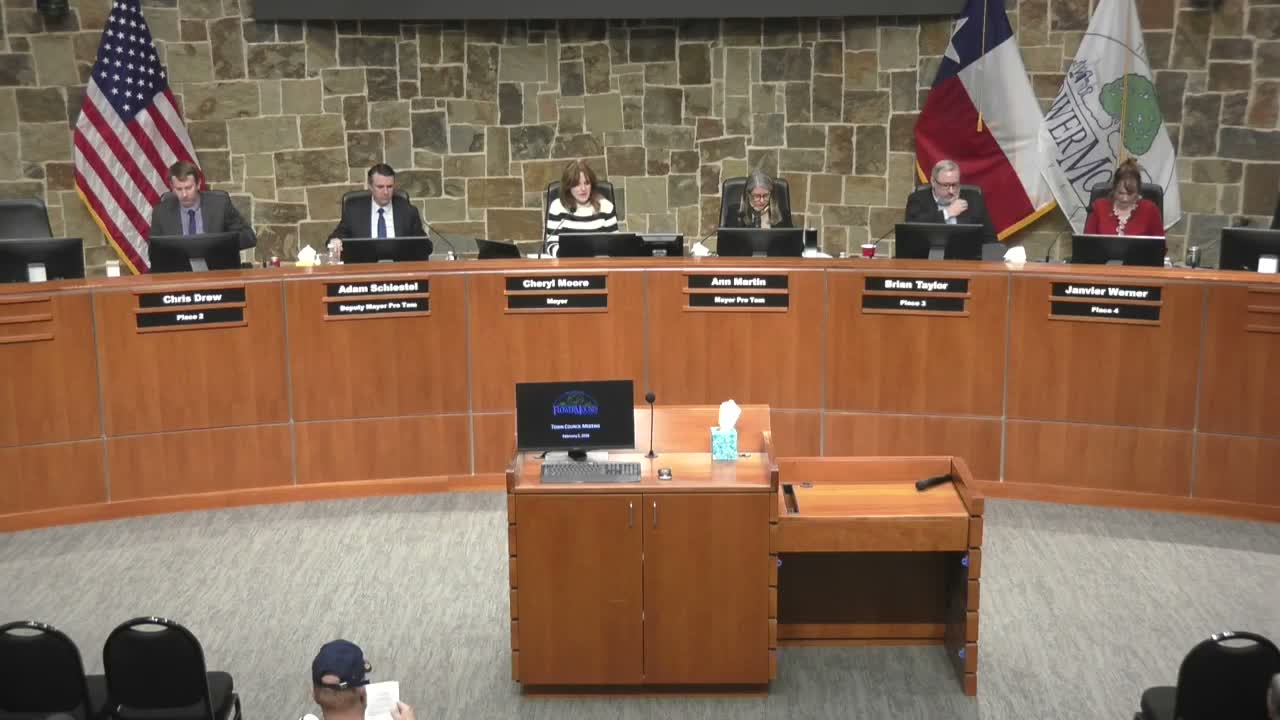
Council fails to override P&Z denial of proposed self-storage at Flower Mound gateway
Summary
After more than two hours of public comment and prolonged council debate, Flower Mound’s council failed to secure the four votes needed to override Planning & Zoning’s denial of a 117,474-square-foot self-storage project proposed at the Flower Mound Road/Old Orchard Lane gateway.
Flower Mound — The town council on Tuesday declined to override a unanimous Planning & Zoning denial of a proposed self-storage development at the northwest corner of Flower Mound Road and Old Orchard Lane, after hours of testimony from residents and a lengthy exchange with the developer.
The applicant sought to amend the existing planned development to allow a 117,474-square-foot mini-warehouse-style facility with architecturally treated facades, backlit mural panels and expanded landscaping. Moniel Gray, the developer representing Charcoal Storage, told the council he had cut building heights, moved rooftop mechanicals to ground level and increased the buffer between the building and nearby homes “to give an additional 40 foot buffer” compared with some prior approvals.
Supporters — many of them residents of the adjacent Orchard Flower 55+ community and the neighborhood HOA — urged the council to approve the project as a low-traffic, single-tenant alternative to unspecified retail that could bring more daily vehicle trips. Gary Noll, a resident who said he had surveyed neighbors, told the council that a well-screened facility and an 8-foot masonry wall could reduce road noise and would likely generate “very little impact” compared with other commercial uses.
Opponents said the size and location of the building make it an inappropriate first impression for visitors entering the town. Several speakers, including Rob Paul, cautioned that granting the requested 58‑foot setback variance (reduced from an earlier 100‑foot request) and allowing a building with two-story massing at the gateway would set a harmful precedent and could depress property values for adjacent homeowners.
Council members split in the final tally on a motion to approve the amendment with conditions that included a restriction on using fill to alter the base grade and tightened gate hours. Council member Drew voted yes, Mayor Pro Tem Martin and Council member Taylor also voted yes; Deputy Mayor Pro Tem Schistel and Council member Warner voted no. Because the application had received a negative recommendation from Planning & Zoning, the council needed four affirmative votes to override; the motion received three and failed.
Before the vote, the developer agreed on the record to adjust operations to address neighbors’ concerns about late-night traffic and gate noise: he was willing to consider narrowing gate access hours and work with the management firm to respond quickly to complaints. “My phone’s always on,” Moniel Gray said, promising to keep lines of communication open with neighbors.
The council’s rejection means the applicant must either redesign within the existing PD exhibits, withdraw the proposal, or return with changes that address council and Planning & Zoning concerns. The council also noted that the existing PD already prescribes a retail layout for the site, two smaller buildings authorized by prior approvals.
The hearing drew sizable turnout: the mayor said staff had logged more than 70 homeowner contacts within the HOA outreach and dozens of emailed comments. After the vote the mayor thanked residents for their participation and closed the public hearing. The applicant may pursue further review or revised plans.