Get Full Government Meeting Transcripts, Videos, & Alerts Forever!
Get email alerts on the Municipal Finance topic
No spam. Unsubscribe anytime.
Flower Mound council reviews fees, property-tax limits as staff outlines FY27 revenue options
Summary
Town staff presented a high-level FY27 revenue framework, asking council to direct modest, data-driven changes to fees (animal services, library, senior center, facility rentals) while warning that large projects and state law limit property-tax flexibility; council asked staff to return with peer comparisons and incremental proposals.
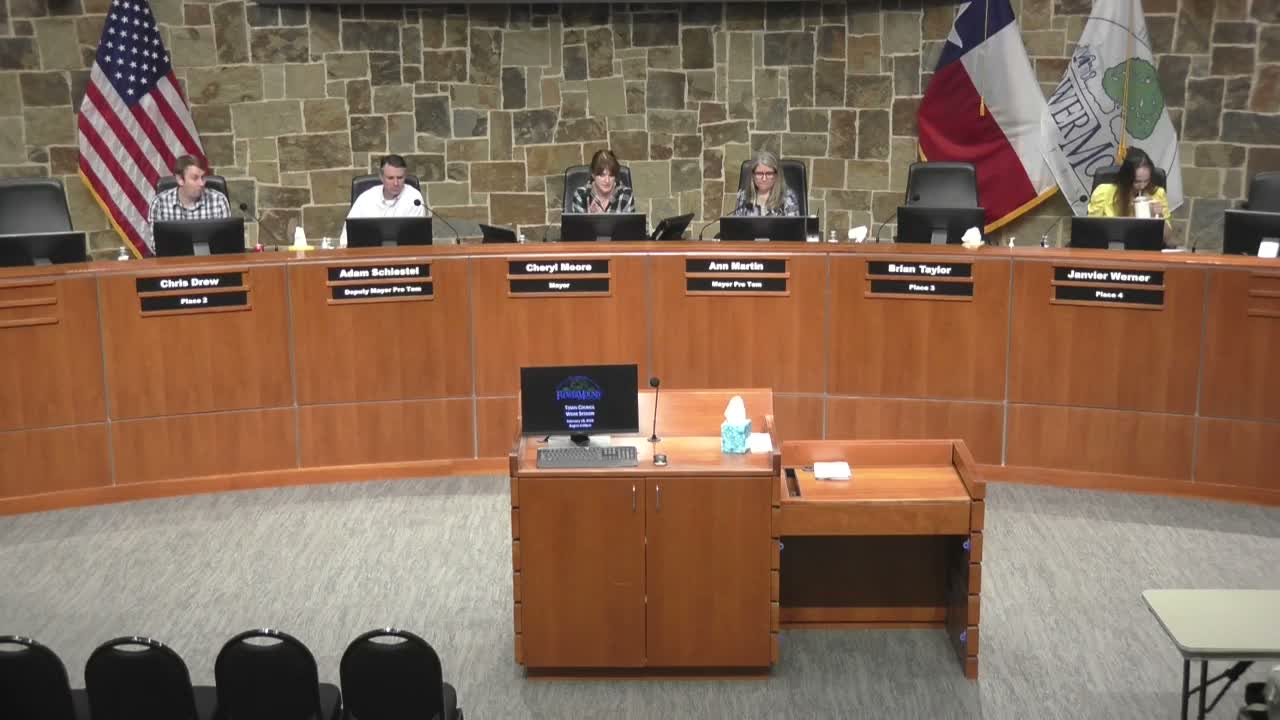
Mayor Mary called the Flower Mound Town Council work session to order and directed the evening’s discussion to FY27 revenue-setting and fee policy, where town Comptroller John Zagarski walked council through cost‑recovery tiers, statutory constraints and options for modest fee changes.
Zagarski told the council that recent state statutes have narrowed local discretion and that revenue-setting now largely centers on fees and property taxes: “we are limited by rules and statutes,” he said, adding that for property taxes “the only discretion you really have is on the maintenance and operations side, and you can go to 3.5 percent.” He said debt issuance is less tightly capped but said the legislature has increasingly restricted allowable uses.
The presentation outlined five cost‑recovery tiers (Tier 1: 0–10% to Tier 5: 91–100%) and three measures staff will report for each service: operational cost recovery, total cost recovery (including capital), and a council target based on a prior council survey. Zagarski said staff used last year’s actuals plus estimated indirect costs and vehicle‑replacement allocations to produce the figures.
On animal services, staff reported overall cost recovery below 1% when capital is included and proposed exploring adoption fees and modest increases to impound/boarding charges. Zagarski noted that doubling impound/boarding fees would yield less than $10,000 annually but that boarding costs run roughly $20–$30 per dog per day. Council members asked staff to compare Flower Mound’s adoption and boarding rates with peer cities and to model whether modest adoption fees would reduce adoption rates or increase owner surrenders.
Library services were next: staff reported under 1% cost recovery and recommended examining loss‑making functions such as printer/copier service (printer lease roughly $5,000 per year) and starting room‑rental fees for public meeting spaces with different resident/nonresident and commercial/nonprofit rates. Zagarski cautioned that elections occupying public rooms reduce rental availability and that staff would propose ways to limit repeated or commercial use (for example, initial free bookings with charges for repeated blocks).
The council also discussed charging nonresidents for remote digital‑material access as subscription costs rise. On late fees, council members reiterated support for continuing the town’s policy of no overdue fines for physical materials and suggested suspension of checkout privileges can be a more effective enforcement tool.
Zagarski said emergency medical services had higher cost recovery (about 30% operational; roughly 32% including capital) and described options to maximize Medicaid and Medicare billing rather than balance‑billing residents. He also described a growing peer‑city practice of billing insurance for certain fire responses (staff emphasized the model would bill insurers, not individuals) and council asked for peer benchmarking and an assessment of potential premium impacts.
On larger facilities and capital projects, staff said Twin Coast Park meets cost‑recovery targets and that planned amenities should increase usage; the Community Activity Center currently sits near the low end of its target but staff expects post‑expansion fee adjustments to move it closer to goals. Zagarski walked the council through major debt assumptions and noted an estimated $80–$100 million police facility and several financing options for a cultural arts center that would affect tax rates or require voter approval. He also warned that some recent legislative proposals could further limit municipal taxing power.
Council members generally directed staff to pursue additional data and peer comparisons, to design modest, phased fee adjustments (for example, a 5% incremental approach suggested for some amenities), and to prepare public engagement materials before formal proposals. Zagarski told the council that any fee increases will require clear disclosure on the budget cover as required by recent legislation: “any fee increases has to go on the front cover of your budget,” he said.
The council took no formal votes during the work session and asked staff to return with detailed recommendations, peer comparisons and fiscal models ahead of the FY27 budget adoption process. Mayor Mary adjourned the meeting at 6:57 p.m.