Get Full Government Meeting Transcripts, Videos, & Alerts Forever!
Get email alerts on the Impact Fees topic
No spam. Unsubscribe anytime.
Flower Mound council reviews impact-fee study as members debate raising fees to 100%
Summary
Consultants presented updated impact-fee calculations showing sharp increases for some service areas; councilors debated adopting maximum assessable fees now, with supporters urging 100% to avoid subsidizing development and others urging caution over large, sudden increases.
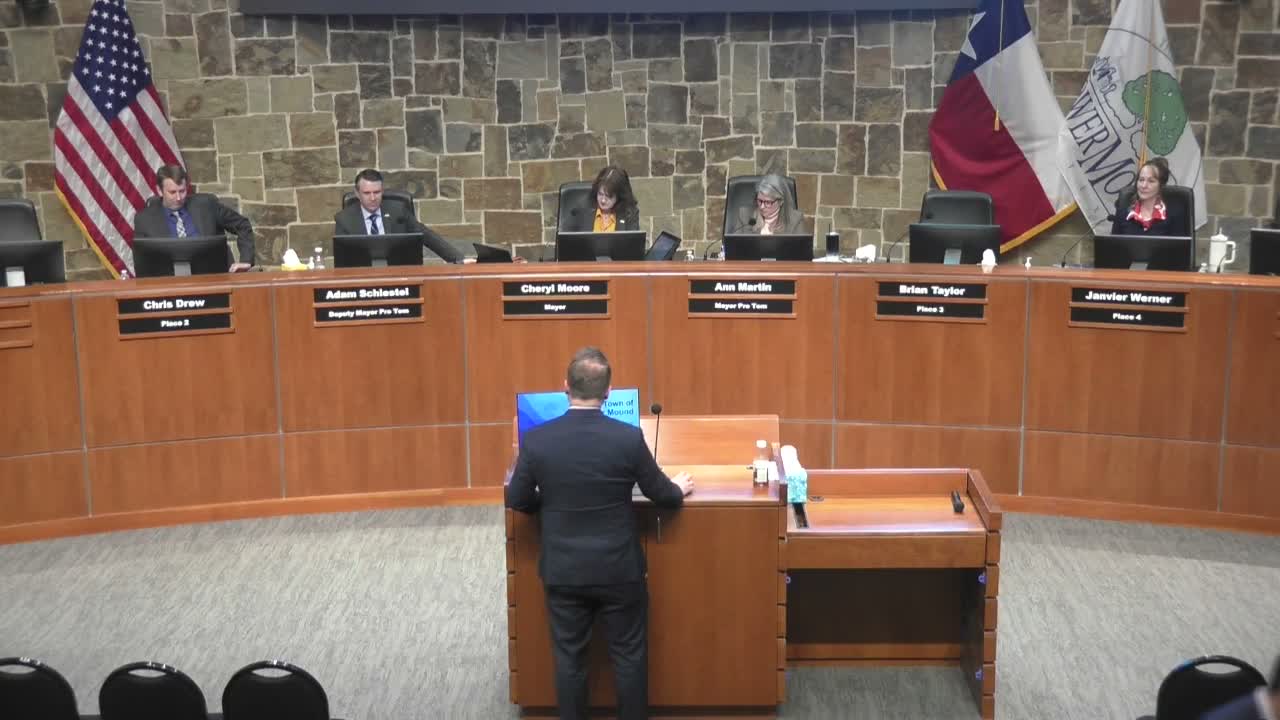
Flower Mound — Consultants from Kimley‑Horn presented an updated impact‑fee study to the Flower Mound Town Council during a work session, outlining substantially higher maximum assessable fees for some service areas and prompting a contested discussion about whether to adopt the maximums now or phase increases over time.
Pete Kelly, the roadway impact‑fee engineer, summarized the study’s methodology and results, saying the maximum assessable roadway fee is calculated by dividing recoverable capital improvement costs by projected service units. He told council that Service Area A’s maximum would be about $682 per vehicle‑mile, Service Area B about $26.97 per vehicle‑mile, and Service Area C about $8,552 per vehicle‑mile. Connor Manley, who presented the water and wastewater analysis, said the 2025 maximum assessable potable‑water fee for a single‑family equivalent is $12,446 (compared with $4,676 in 2020) and that existing adopted fees are at 80% of prior maximums.
“I’m just gonna make this statement,” a council member (Speaker 1) said during deliberations. “This is my take on impact fees…not in Flower Mound, where they’re beating our door down to build houses and develop. So it should be 100%. It should be 100% right now as soon as we can get it.”
Other council members disagreed on timing and magnitude. Several members expressed concern that adopting the full maximums immediately would impose a sharp cost increase on developers and could have downstream effects on housing‑cost calculations and project viability. Consultants noted state law changes that require a third‑party audit and limit how often fees may be increased (no more than once every three years), but they also said the council can adopt a phased escalation plan at one vote if it chooses.
Counsel discussed the policy tradeoffs: setting fees at 100% shifts near‑term infrastructure costs to developers and new growth, while adopting a lower percentage effectively subsidizes development with existing taxpayers. The consultants confirmed that impact fees are charged based on the plat date (the rate is set at plat date and collected at permit), which means many projects in the pipeline would retain older, lower rates if the new fees are adopted.
The presentation closed with procedural next steps: the consultants will meet the Capital Improvements Advisory Committee in early March and return to council for adoption and the statutorily required audit hearing at the April public hearing (currently scheduled for April 20). Council did not vote on fee rates at tonight’s meeting.
Why it matters: impact fees are a one‑time charge on new development meant to recover the town’s cost of new roads, water and wastewater infrastructure. Choosing a lower than maximum fee effectively leaves existing residents subsidizing infrastructure for new development; choosing the full maximum can impose significant additional costs on builders and could be politically sensitive.
Provenance: topic began with Kimley‑Horn’s roadway presentation and Q&A (Pete Kelly, SEG 2200) and continued through council questions and policy discussion concluding in the work‑session block (SEG 2808).