Get Full Government Meeting Transcripts, Videos, & Alerts Forever!
Get email alerts on the Student Devices topic
No spam. Unsubscribe anytime.
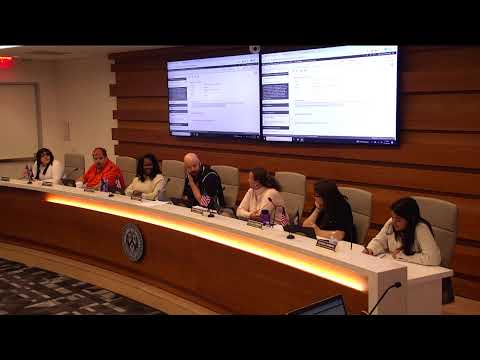
Manassas Park school board holds first reading of cell-phone policy, debates medical exceptions and storage rules
Summary
At a Nov. board meeting the Manassas Park City School Board held a first reading of a draft cell phone and portable electronic device policy required by a governor's executive order; members debated medical-device access, whether backpacks count as 'on person,' and enforcement procedures. The board will return the policy for a second reading in December.
The Manassas Park City School Board on Monday held a first reading of a draft policy that would restrict student use of cell phones and portable electronic devices during the school day, with trustees focusing their questions on medical exceptions, where devices may be stored and how enforcement would work.
The reading comes after an October work session and follows a governor's executive order requiring school divisions either to adopt the state model policy or an equivalent by Jan. 1. Board leadership said staff drafted local language and will bring the policy back for a second reading and vote at the board's December meeting.
"Tonight is first reading and discussion for the board," a board member who introduced the matter said, noting the draft will return in December for second reading and approval. "From that meeting as well as input from you as individuals, [staff] has put together the draft policy for the cell phone portable electronic device." (Introduced by a board member.)
Chair Sheryl Alexander, who took part in the line-by-line discussion, said she supported several additions in the draft, including a prohibition on device use in restrooms and locker rooms and explicit coverage of personal devices capable of connecting to smartphones. "I did like the addition of the language specifically around personal devices capable of connecting to a smartphone," Alexander said.
Trustees pressed staff on how the policy would treat items stored in backpacks versus devices kept on a person. "Right now it says not in a pocket, but I wanted to make sure that are our backpacks included in the on persons kind of that discussion," Alexander said.
A district administrator responded that backpacks would be permitted as storage during the bell-to-bell instructional day, and principals and building stakeholder committees are considering other storage options such as pouches. "Currently, as long as it's not in their physical pocket, backpacks would be permissible for where they could store their devices," the administrator said.
Board members also discussed wearables and smartwatches. Alexander said she "liked the smartwatch and wearable devices inclusion in the policy" but raised enforcement concerns about day-to-day monitoring.
Trustees and staff spent notable time on medical and Individualized Education Program (IEP) exceptions. One trustee warned that students with type 1 diabetes may rely on Bluetooth-connected glucose monitors that communicate with a phone. "With the medical aspect, I just think a word of caution, especially with type 1 diabetes. A lot of times there it's a Bluetooth monitor," a trustee said, urging that students with those medical needs retain access to required devices.
Staff said they are mindful of medical needs and will ensure access remains available in close proximity during the day while the policy is operationalized by building-level procedures.
Board members also asked about practical steps for students who need to make phone calls during the day. The district confirmed phones are available in front offices and said staff are drafting a job description to support increased front-office phone needs. The administrator said building-level regulations will set how and when students access those lines and that those procedures may vary by school level.
The draft policy is a first reading only; no final action was taken. The board plans to continue the discussion and will return the matter for a second reading and potential vote at the Dec. 16 regular meeting.
What happens next: The board will review public-facing regulations and building-level procedures after adopting a final policy; staff said they will work with principals and stakeholder committees on operational details such as storage solutions, enforcement consistency and accommodations for medical and IEP-related needs.