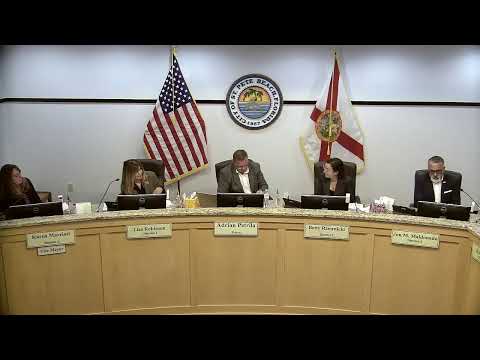
St. Pete Beach approves staff language on wireless rules after heated public debate over setbacks and safety
Loading...
Summary
After hours of public comment urging 30‑foot setbacks and 500‑foot spacing for small wireless facilities, the St. Pete Beach commission approved staff‑recommended language on first reading that emphasizes safety, aesthetic standards and negotiated alternatives while warning numeric separation may conflict with state law.
The St. Pete Beach City Commission on Feb. 26 debated proposed amendments to the city’s wireless-communications code after a packed public-comment period in which residents urged fixed setbacks and spacing rules for small wireless facilities.
At issue were two citizen proposals: a 30-foot minimum setback from private property lines or structures and a 500-foot spacing standard for ground-mounted equipment. Dozens of residents, including Lauren Moniz and Kelly Lee McFrederick, urged the commission to adopt numerical protections, saying poles had been placed ‘‘right in front of homes’’ and citing safety, privacy and property-value concerns.
City Attorney Ralph Brooks and staff advised that state law (Fla. Stat. § 337.401 and related provisions) restricts local ability to impose minimum separation distances and can make numeric rules vulnerable to legal challenge. Brooks explained staff’s compromise: retain the goals (safety, aesthetics and avoidance of placement directly in front of residences), add ‘‘whenever technically feasible’’ language, and use the statutory negotiation clause to request alternative locations rather than require a public-hearing variance that may be preempted.
Industry representatives including Matt Mucci of AT&T told the commission that the carriers support some of the staff language and emphasized that many facilities are small pole-mounted attachments to existing utility poles rather than ‘‘towers.’’ Mucci said AT&T installed a small number of facilities in 2025 and supports the version of the code presented for the second-reading packet.
Commissioners spent substantial time weighing legal risk versus community demands. Several commissioners said they want stronger guardrails but worried about exposing city taxpayers to an expensive lawsuit the city could lose. Commissioner comments ranged from urging a bold local stand to recommending careful drafting that can withstand state preemption.
After deliberation the commission voted unanimously to adopt staff-recommended language on first reading; the vote moves the ordinance to a second reading where final wording may be revised. The city attorney said the Department of Legal Affairs will review the ordinance and that state review delays an ordinance’s effective date by 30 days from submission.
What’s next: staff will return with refined language for second reading, and the commission signaled interest in pursuing parallel advocacy (coordination with lobbyists and the Florida League of Cities) to seek broader statutory change.