Get Full Government Meeting Transcripts, Videos, & Alerts Forever!
Get email alerts on the Therapy Dogs topic
No spam. Unsubscribe anytime.
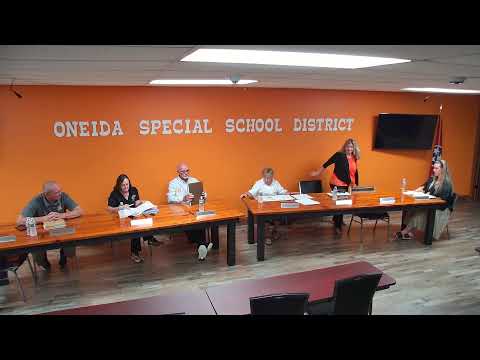
Board discusses therapy-dog pilot after Franklin Special School District visit; director says budget can cover a dog
Summary
After visiting Franklin Special School District, the director described therapy dogs working in classrooms and halls, urged a pilot in Oneida, and said an individual dog costs roughly $5,000 with volunteer handlers and training; trustees were generally supportive and the director plans to include the item in the budget discussion.
The director reported a recent visit with trustees to Franklin Special School District to observe therapy dogs in schools and recommended the district consider a therapy-dog pilot. "You can watch these dogs, and you can imagine what you can do in your own school system," the director said, describing dogs named Wilson, Parker and Star that moved through classrooms and halls, calmed students, and worked without disrupting instruction.
The director told the board therapy dogs are managed by a primary and secondary handler so the dog remains available when one handler is absent. She said the Franklin program relied on volunteer handlers, donated food and community support, and that the district could likely fit a dog into the budget. "We do have it in the budget, and it's not really as much as you think," the director said, estimating a per-dog cost around $5,000 while acknowledging costs can vary.
Trustees discussed logistics and constraints: members asked about how students who are not allowed around dogs would be accommodated, handler training and supervision, rest schedules for the animals and whether the dogs would be limited to elementary schools for the pilot. One staff member said the elementary school would be the logical starting point because students and teachers there had indicated support.
Why it matters: Board members and staff framed the program as a tool to reduce stress among students, support social-emotional needs and improve students' engagement. The director cautioned that while anecdotal benefits are clear, some program leaders said measurable "return on investment" is difficult to quantify, and the board discussed relying on volunteer support and existing budget lines for an initial pilot.
Next steps: The director indicated she would propose inclusion of the program in the upcoming budget for trustees to consider; no formal pilot approval or purchase occurred at the meeting.