
Arkansas presenters credit statewide HIE, convening and legislation for multi‑payer value gains, but warn of legal and resource hurdles
Get AI-powered insights, summaries, and transcripts
Subscribe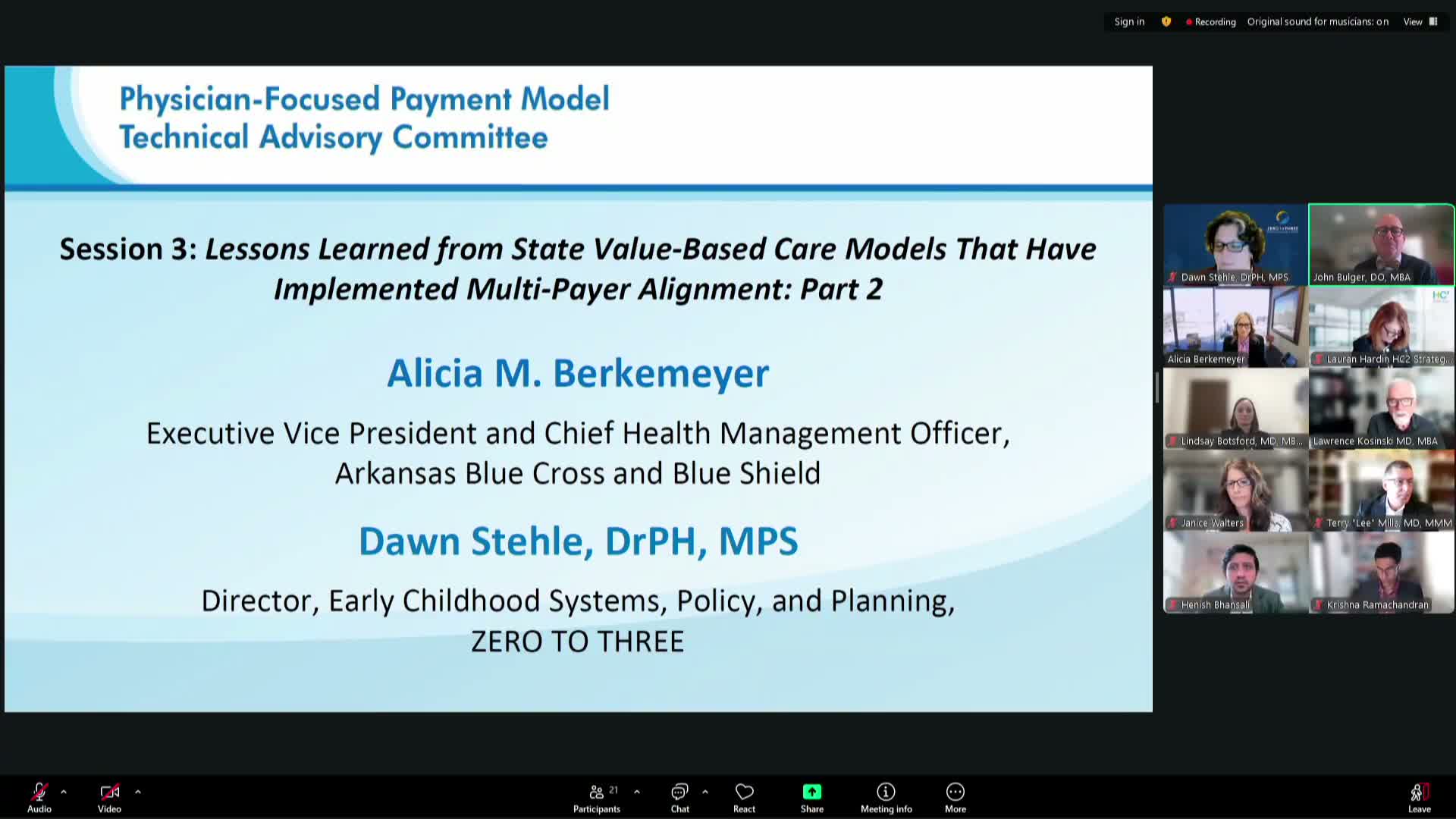
Summary
Arkansas Blue Cross, a former Medicaid director and partners described a sustained multi‑payer effort that used health‑information exchange, aligned quality measures and targeted legislation on primary‑care spend to advance value‑based care; they noted ongoing issues with payer participation, reporting burden and antitrust/legal constraints.
Alicia Buechelmeyer, executive vice president and chief health management officer at Arkansas Blue Cross and Blue Shield, and Don (name given only as Don), who served as Arkansas’ Medicaid director and now works with Zero to Three, described Arkansas’ multi‑payer journey to PTAC as a decades‑long effort that combined payer pilots, an HIE, an all‑payer claims database and legislative action.
They said Arkansas built value programs in stages—starting with patient‑centered medical homes and CPC pilots, moving to episodes‑of‑care work and then to statewide alignment on measures and attribution. Alicia said the state’s health information exchange, administered under the Arkansas health department, plus an all‑payer claims database enabled daily hospitalization reports, admission/discharge notifications for case managers and better attribution for practices.
Policy and funding levers: Speakers credited state and federal funding sources and collaborative grants for early work (including CMMI/State Innovation Model support). They noted a recent legislative effort to define and report primary‑care spend across payers, with committee reports due to the legislature and new APCD fields being added to capture value‑payment data.
Practical innovations and examples: Panelists highlighted behavioral health integration networks and local experiments—examples ranged from social workers riding with police to deploy supports, to clinics using value dollars to fund modest social services (a washer/dryer or a small gym) so care coordinators could engage patients more effectively.
Barriers: Panelists said major constraints remain. Don emphasized the need to secure employer and payer buy‑in (including large employers such as Walmart); both speakers described antitrust and legal boundaries requiring some payment elements to remain separated even while much of design work can be collaborative. They reported that roughly 90% of model development work can be done jointly, while payment levels and specific contractual terms must stay distinct.
Why it matters: Arkansas’ experience shows how state‑level data systems and inclusive stakeholder convening can drive multi‑payer alignment, but also that scaling depends on funding for convening, careful antitrust/legal work and reducing measurement burden for small, resource‑constrained practices.