
PTAC experts push faster shift to value‑based care, cite data and payer alignment as bottlenecks
Get AI-powered insights, summaries, and transcripts
Subscribe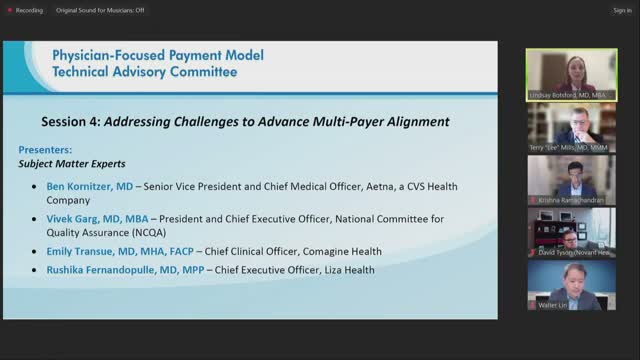
Summary
At a PTAC public meeting session, federal advisers and industry experts identified data fragmentation, misaligned quality measures and weak commercial‑payer participation as the main barriers to multi‑payer alignment; speakers urged investment in primary care, standardized digital measures and phased 'road to risk' payment paths.
Day two of the Physician‑Focused Payment Model Technical Advisory Committee (PTAC) public meeting centered on practical steps to align multiple payers behind value‑based primary care, with panelists from payers, standards organizations and provider innovators describing technical, contractual and market barriers and offering specific remedies.
Dr. Ben Kornitzer, senior vice president and chief medical officer at Aetna, said patients and clinicians face fragmented systems that limit longitudinal care and drive avoidable costs. "Forty percent of consumers report that they are delaying care due to cost," Kornitzer said, adding that "88 percent of physicians report that they want more time to spend with complex patients." He argued that more timely, bidirectional data sharing and financial stability for primary care are necessary to sustain value‑based models.
Vivek Garg, president and CEO of the National Committee for Quality Assurance (NCQA), told the committee that alignment breaks down around four gaps: trust and data transparency, accountability without control, wide variability in contract terms, and multi‑payer complexity. He recommended a parsimonious core measure set, stronger digital quality measurement using USCDI and FHIR standards, and harmonized incentives across Medicare, Medicaid and commercial lines.
Emily Tranzu, chief clinical officer at Comagine Health, described Washington State's multi‑payer primary care transformation as a case study in convening payers and providers, noting the role of memoranda of understanding, a legislatively mandated common measure set and a neutral convener to manage antitrust risks. She emphasized social risk adjustment for Medicaid populations and the value of using state levers to require payer participation where appropriate.
From the provider perspective, Dr. Rishika Fernanapule, chief executive officer at Iora Health, recounted building an alternative primary care model that pairs health coaches and integrated behavioral health with new operating platforms and payment arrangements. She described staged contracts that moved practices from a primary‑care cap to increasing upside and downside risk over several years—what she called a "road to risk"—and cited a 22.3% net savings rate in the first full year of a Center for Medicare & Medicaid Innovation demonstration involving direct contracting.
During committee Q&A, members pressed presenters on interoperability and measure development timelines. Krishna Ramachandran, chief information officer at UnitedHealthcare, asked how fragmentation could be reduced nationwide; panelists emphasized patient‑centric data access, standards adoption and realistic timelines for organizations with different capacities to implement FHIR and related standards. Larry Kosinski, a PTAC member and retired gastroenterologist, asked whether NCQA could accelerate measure approval; Vivek Garg acknowledged the need to speed parts of the scientific and feasibility process while preserving measurement integrity.
Speakers repeatedly returned to two policy levers: investment in primary care capacity and alignment of quality and payment signals. Panelists stressed that getting commercial payers to participate at scale is the remaining obstacle: "Until we get the commercial insurers on board, it's going to be very hard for the vast majority of practices to actually transform," Fernanapule said.
The session also explored rural adaptations, with presenters warning that frontier and rural settings require more generous upfront funding, looser standardization rules where necessary, telehealth and creative workforce strategies to preserve access. Panelists urged policymakers to balance standardization with local flexibility.
PTAC will accept public comment at the scheduled period and said discussion materials and public comments will inform its report to the Secretary of the Department of Health and Human Services. The committee also reminded the public of posted background materials and issue briefs on the ASPE PTAC website.
The meeting recessed for a break and will reconvene for public comment and final committee discussion later in the day.