Get Full Government Meeting Transcripts, Videos, & Alerts Forever!
Get email alerts on the Land Development topic
No spam. Unsubscribe anytime.
Mesquite council denies developer’s appeal of impact fees for I‑30 office expansion
Summary
After a public hearing and executive session, the council denied an appeal by James Best’s representatives seeking waivers of city impact fees for a 10,000‑square‑foot office expansion at 880 I‑30, concluding staff had followed ordinance and state law.
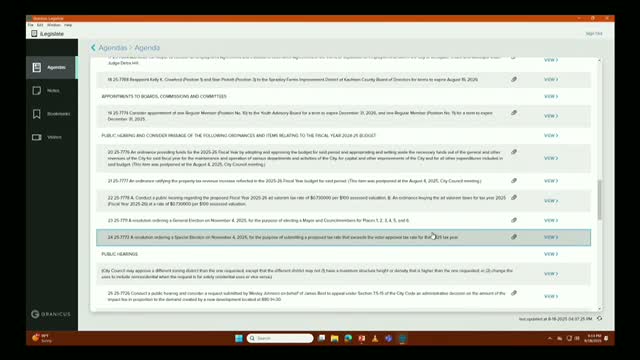
The Mesquite City Council voted unanimously on Aug. 18 to deny an administrative appeal by developer James Best contesting impact fees assessed for work at 880 Interstate 30.
City planning staff told the council the municipality calculated the fees according to city code and state law and that the appellant supplied no engineering evidence showing the fee was miscalculated. "When it comes to an appeal, the applicant needs to provide proof that the fee was either calculated incorrectly or is too high," Planning Director Adam Bailey said in his briefing.
Attorney Wesley Johnson, representing Best, argued the project imposed no measurable expenses on Mesquite and invoked a recent U.S. Supreme Court decision he described as requiring a "rough proportionality" showing by the city. Johnson said the addition sits behind an existing building and uses a private drive, and he urged a refund of approximately $91,000 the developer had paid.
The council recessed to a private legal consultation under Texas Government Code §551.071, then returned and voted 7–0 to deny the appeal. City legal counsel confirmed in open session that the city's preparation and application of impact fees had followed state law and available engineering analyses.
The denial leaves the assessed fees in place; the developer may pursue other legal remedies outside the council process. Council and staff emphasized that impact fees are generated from engineering studies and applied by formula that accounts for expected water, sewer and roadway impacts tied to new development.