
Committee sends bill directing study of insurance coverage for recovery housing to calendar
Get AI-powered insights, summaries, and transcripts
Subscribe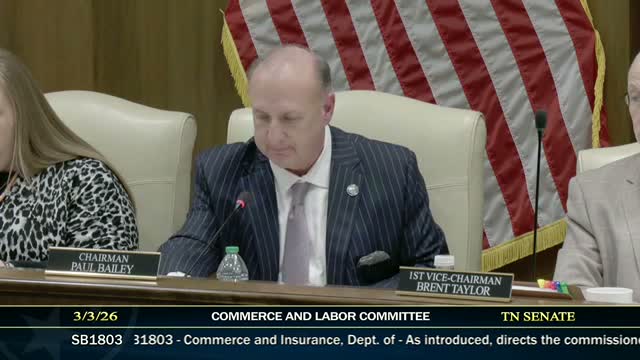
Summary
SB 1803, amended to direct the Department of Commerce and Insurance to study coverage and reimbursement models for recovery housing and related supports, advanced after testimony from Sean Baker of Freeman Recovery Center that such supports reduce costs and improve outcomes for people with substance-use disorders.
Sponsor Chairman Jackson told the committee that SB 1803 would require the commissioner of the Department of Commerce and Insurance to study how neighboring states address substance use disorders through insurance coverage and reimbursement models, including coverage for recovery housing.
Sean Baker, founder and CEO of Freeman Recovery Center in Dixon, testified in favor of the bill. "At our own facility, housing costs nearly 10 times less than the treatment," Baker said, arguing that stable recovery housing reduced emergency visits, inpatient stays and recidivism. "Programs that connect individuals to stable housing have documented substantial reductions in emergency room visits," he said, and urged the committee to adopt a data-driven study rather than mandate any specific benefit design.
Baker described evidence that abstinence and employment outcomes are better for residents of recovery housing. He told the committee the proposed study would identify which payer models and reimbursement structures work best and return evidence-based recommendations to the legislature by Dec. 31, 2026.
The committee adopted the amendment that makes the bill and voted to move SB 1803 to the Senate calendar. The clerk recorded eight ayes; no opposition was recorded in committee.
The bill does not itself require coverage; rather, it directs a state study to report options for potential future policy changes.