Get Full Government Meeting Transcripts, Videos, & Alerts Forever!
Get email alerts on the Land Use Childcare topic
No spam. Unsubscribe anytime.
Frisco planning commission tables Primrose daycare after debate over sound and proximity to homes
Summary
The Frisco Plains Planning & Zoning Commission on a 5-0 vote tabled a Primrose School specific-use permit to March 25, asking the applicant for revised site drawings and independent or modeled acoustical analysis to resolve concerns about playgrounds adjacent to nearby homes.
The Frisco Plains Planning & Zoning Commission on Tuesday voted 5-0 to table a request from Primrose Schools for a specific-use permit to operate a 250‑student childcare center, directing staff and the applicant to provide additional acoustical analysis and revised site drawings ahead of a March 25 continuing hearing.
Staff recommended denial, saying the current site configuration places required outdoor play areas too close to adjacent residential neighborhoods and therefore does not comply with the city’s 2015 comprehensive‑plan guidance that playgrounds be located away from residences. As staff summarized the request, “The request before you is for a child care center with a maximum enrollment of 250 students,” and recommended denial based on that policy.
Applicant attorney Bill Dahlstrom, who represented Primrose, defended the site layout and mitigation measures. He said the project would operate 7 a.m. to 6 p.m. and that the design includes an 8‑foot masonry wall on the north and east property lines to screen the playgrounds. “We intend on having 250 children,” Dahlstrom said, and he cited a sound study the applicant provided showing peak levels around 65 decibels at a comparable Primrose location.
Cross Architects’ representative Mike Lisi said the playground layout reflects operational choices — separate yards for different age groups — and argued that relocating play areas or reconfiguring the building would require a substantial redesign and additional property. Lisi described the role of mass in acoustic control: “Mass is kind of the holy grail as far as sound walls,” he said, adding that a second wall or other treatments could be considered.
Commissioners and staff pushed back on the study’s scope and provenance. Staff and several commissioners noted the study used recordings or modeling from a different Primrose site and that one recording did not include the late‑afternoon hours the proposed center would operate. Commissioners asked for an independent review or modeling that compared sound levels with and without the proposed secondary wall(s) and asked staff to confirm any public‑safety or CPTED concerns about creating a narrow alley or “canyon” between staggered walls. One commissioner asked the applicant to provide a study that shows the effect of adding walls or dampening materials rather than relying on a single version of the analysis.
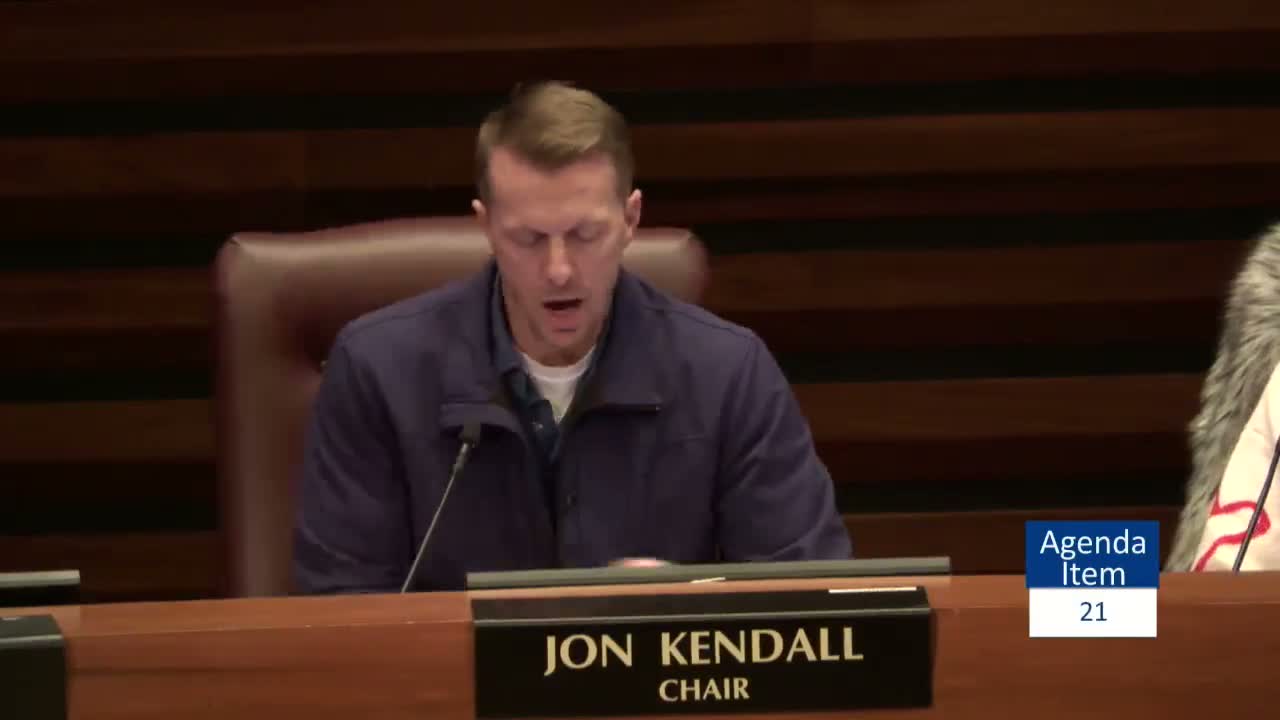
Given the outstanding questions, the commission voted to reopen the public hearing and to table the item to the March 25 meeting. In the motion commissioners asked that the applicant submit revised drawings that show any proposed secondary wall(s), provide a more complete acoustical report (including worst‑case and late‑afternoon scenarios), and be prepared to fund a city review or independent verification where appropriate. Chair John Kennel closed the exchange by recording the tabling action: “This has been tabled to the March 25 meeting.”
Next steps: the applicant and staff will return with the additional acoustical information and revised plans on or before the March 25 meeting; the public hearing will remain open when the case returns.