Get Full Government Meeting Transcripts, Videos, & Alerts Forever!
Get email alerts on the Land Use Zoning topic
No spam. Unsubscribe anytime.
Frisco planning panel approves Miller Minor Automotive SUP after months of neighborhood opposition
Summary
The Frisco Planning & Zoning Commission approved a specific use permit allowing a 3,000-sq-ft minor auto repair shop in Cobb Business Park, contingent on a dividing wall before a certificate of occupancy and an explicit ban on muffler work; neighbors had argued the building as a whole sits within the ordinance's 250-foot adjacency limit.
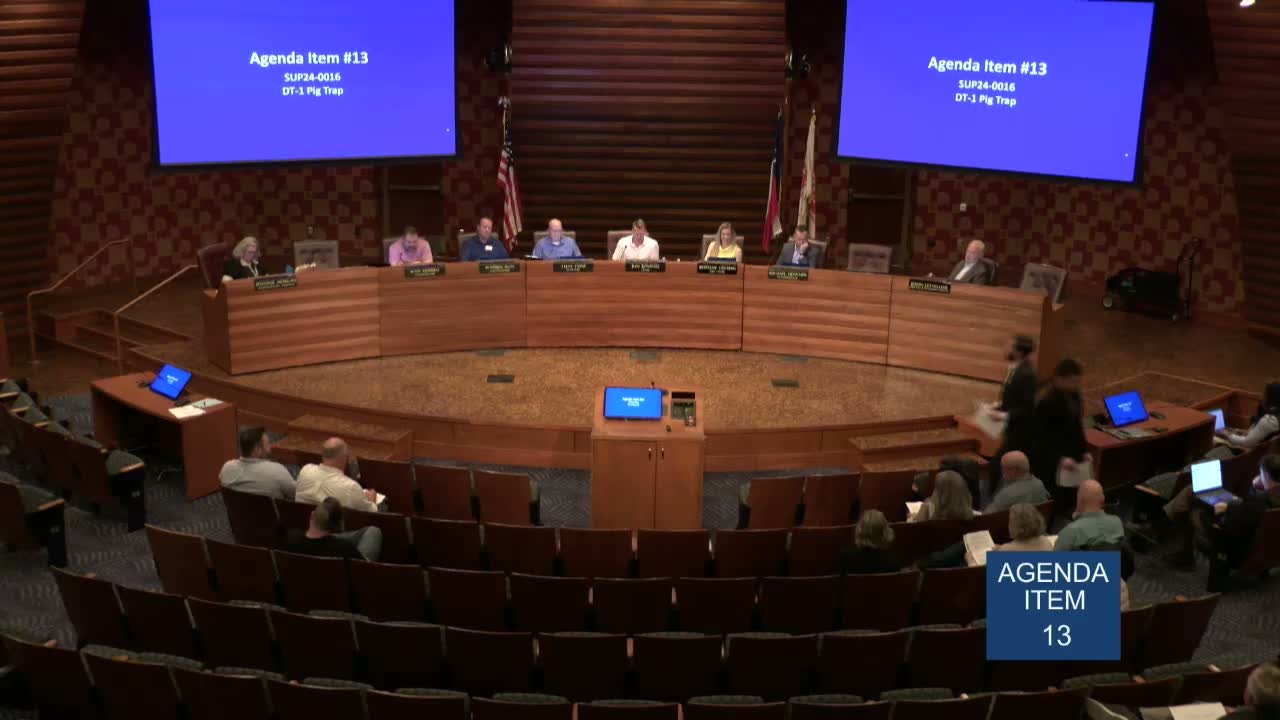
The Frisco Planning & Zoning Commission voted 5-0 to approve a specific use permit allowing a limited minor automobile repair operation in a portion of Building 6 at Cobb Business Park, adding conditions that a solid dividing wall be installed as shown on the plans before a certificate of occupancy and that muffler work be strictly prohibited.
Chair John Kendall opened the public hearing and staff summarized the request as a revised proposal: the applicant reduced the business footprint from a prior major-repair request, proposed subdividing the building into two suites so the western suite for automotive work meets the 250-foot adjacency standard, and asked that the SUP be tied to the meets-and-bounds legal description shown in the exhibits. Staff said it received a growing volume of public input forms (a staff tally cited 67 opposed and 4 in favor as the most recent count) but recommended approval of the minor-repair SUP as submitted, with conditions in the staff report and the correction that the request was for "minor" rather than "major" automobile repair.
Carter Ferguson, the property owner and applicant, told commissioners he had scaled back operations to eliminate the service types neighbors opposed and would confine automotive activities to the western suite. "We're no longer doing a muffler shop," Ferguson said, adding he had ordered equipment early and that lifts placed in the space were not yet operational. He estimated the western suite would operate roughly 8 to 10 customer cars per day and said he would work with neighbors.
Multiple Meadow Hill Estates residents urged denial. Kim Martin said the adjacency provision in the zoning ordinance requires automotive-related buildings be 250 feet from residential zoning and argued the ordinance language refers to a building, not a portion of one. "It says all buildings ... shall be located a minimum of 250 feet from a residential zoning district," Martin said, noting concern that allowing a wall to define the SUP area would leave enforcement to neighbors in future years. Andrew Earhart and other opponents pointed to the applicant's other locations and online materials that describe exhaust and customization services, saying that evidence shows the business often provides services the ordinance classifies as "major" repairs.
Commissioners pressed staff and the applicant on enforceability. Jonathan Hubbard explained SUPs are tied to the legal description in the application and that code enforcement would investigate violations; the city attorney's office previously advised staff on similar cases. Hubbard clarified how the 250-foot measurement is applied relative to the single-family zoning boundary and noted the staff measurement showed the tied suite met the 250-foot threshold.
Commission debate acknowledged competing considerations: several commissioners said they sympathized with long-time residents' concerns about noise and property values but also emphasized the commission's obligation to weigh property-owner rights and to follow staff and legal guidance. Commissioners asked that the record include a clear measurement method for the council packet and sought explicit conditions limiting operations to the minor-automotive definition.
When the motion was called, the commission approved staff's recommendation as amended: correct the staff report language from "major" to "minor," require the dividing wall shown on the drawings before issuance of a certificate of occupancy, and prohibit muffler work at the facility. John Kendall said the case will be scheduled for the May 6 city council meeting for final action.
The commission's approval does not grant automatic expansion of the use beyond the legal description; staff said any change would require a new public hearing. If residents later believe the business is operating outside the SUP conditions, the city's code-enforcement division or police (for noise complaints) may investigate; revocation of an SUP would require another public hearing and city action.
The Planning & Zoning Commission concluded deliberations after roughly two hours of public comment and staff Q&A.