
Committee advances bill to enforce 340B protections as hospitals, clinics warn of lost access
Get AI-powered insights, summaries, and transcripts
Subscribe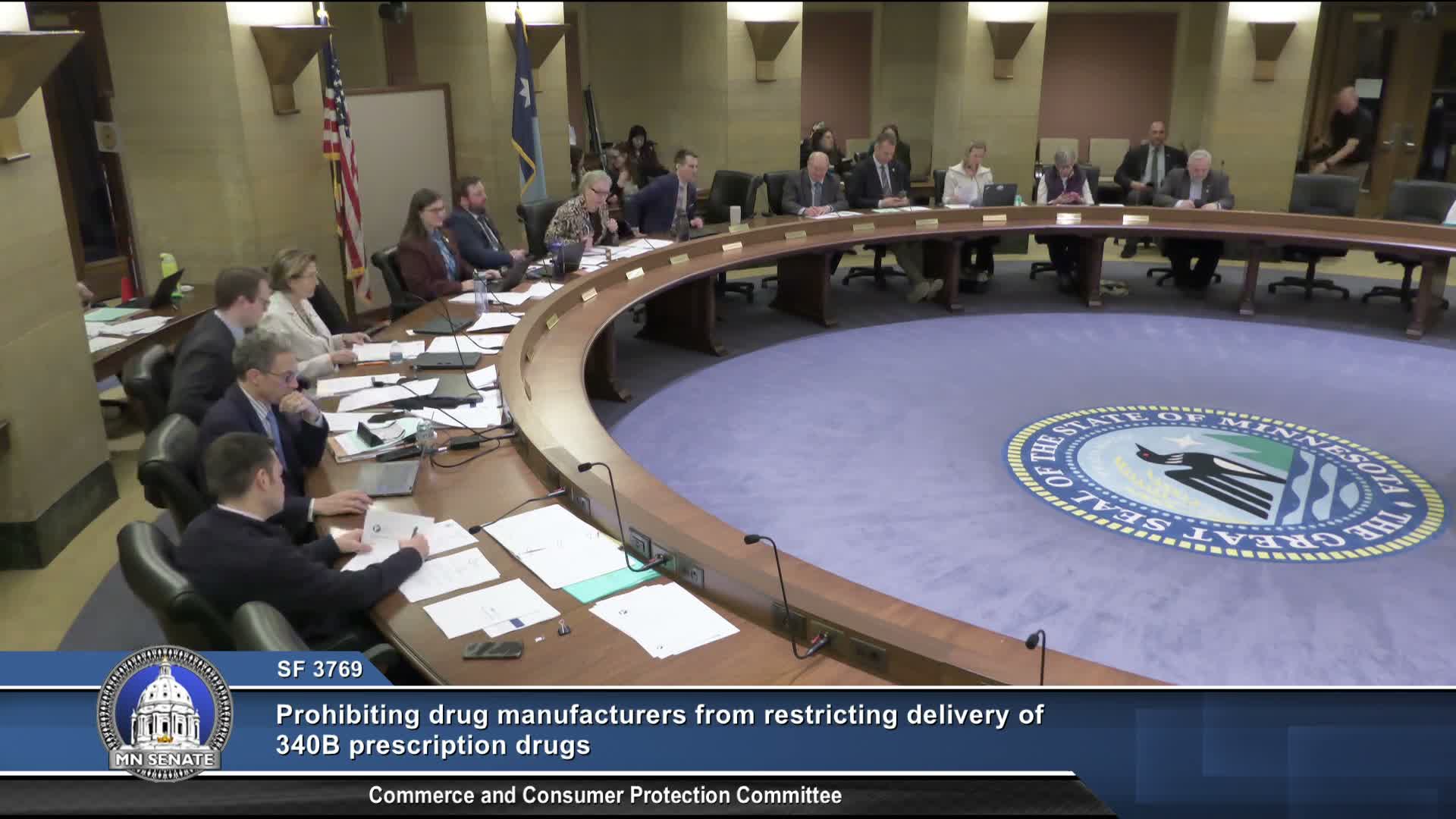
Summary
Senate File 3769 would provide state enforcement for 340B manufacturer obligations; rural hospitals and FQHCs urged passage to protect services dependent on 340B savings, while manufacturers and others warned the program needs reform and study. The committee voted to send SF3769 to Judiciary.
Senator Klein opened discussion of Senate File 3769 by framing it as a choice to protect Minnesota patients and safety-net providers from unilateral manufacturer restrictions on 340B contract pharmacies. The sponsor said the bill provides enforcement capacity for the 340B statute already enacted in Minnesota.
Senator Rasmussen offered an A1 amendment to require claims-data sharing to protect program integrity but later withdrew it after members and witnesses debated data-sharing burdens and privacy concerns. Testimony from rural hospitals underscored the program's role in sustaining essential services: Carrie Mikulski, president and CEO of Riverview Health, said Riverview generates approximately $2.2 million annually in 340B savings that sustain maternal care and other services, and that the hospital had a cumulative operating loss of $13 million over three years.
Lisa Birga, president and CEO at Lakewood Health System, described 340B as essential for rural hospitals' ER, EMS and obstetrics services and said their community benefits and charity care rely on these discounts.
FQHCs and community health advocates said contract-pharmacy relationships are necessary for patient access in rural areas; Rochelle Westland noted that some clinics lack on-site pharmacies and that limiting contract pharmacies would force patients to travel long distances.
Pharma and manufacturers (represented by Jessica Lynch, Emily Ghibellina of AbbVie, Genevieve Plomidore of BMS) opposed immediate permanent changes, urging more study and noting the 2024-25 MDH reports show concentration of 340B revenue among large hospitals and potential perverse incentives. They warned the program growth can increase overall healthcare spending and that federal audits and HRSA oversight exist.
Committee members voiced competing priorities: protecting rural hospital access and guarding against program misuse. After debate and testimony, the committee voted to recommend SF3769 to pass and refer it to Judiciary and Public Safety.
What happens next: SF3769 was recommended to pass and sent to Judiciary for further work, including possible provisions on enforcement and program integrity.