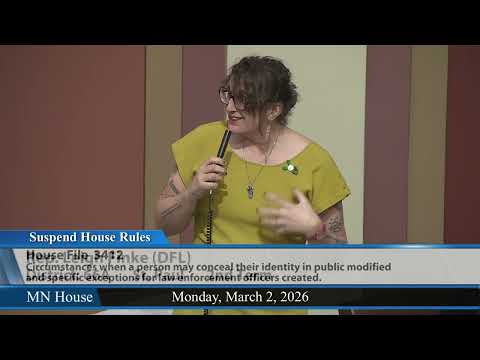
House rejects motion to advance bill that would bar masked federal agents

Minnesota House of Representatives · March 2, 2026

Get AI-powered insights, summaries, and transcripts

Subscribe
AI-Generated Content: All content on this page was generated by AI to highlight key points from the meeting. For complete details and context, we recommend watching the full video. so we can fix them.

Summary

On Feb. 26, 2026, the Minnesota House debated House File 3412, a bill by Rep. Finke to require law‑enforcement officers operating in Minnesota to be unmasked, including federal agents. After extensive debate and a roll‑call, the motion to recall the bill for final passage failed as recorded by the clerk.

Saint Paul — The Minnesota House on Feb. 26 debated House File 3412, a proposal by Representative Finke that would bar law‑enforcement officers from wearing masks while performing official duties in Minnesota, and would apply the state’s unmasking requirements equally to local, state and federal officers. Representative Finke told colleagues the bill is aimed at preventing what she described as “secret police” and restoring public trust.

Finke said, “It is a bill that would unmask law‑enforcement agents in the state of Minnesota whether they are local, state, or federal law enforcement agents.” She argued that masked, unidentifiable officers erode public trust and cited recent incidents she said showed harm to communities.

Supporters framed the measure as a transparency and public‑safety reform. Representative Curran, who identified experience with law enforcement and community response, said policing is a calling that depends on trust; Curran cited “almost 11,000” licensed peace officers in the state as part of a broader argument that identity and accountability matter. Representative Long said identification is a “bare minimum” the public should expect of officers operating in communities.

Opponents said the bill is unnecessary, poorly drafted, and risks interfering with legitimate officer safety needs. Representative Novotny called the measure ‘‘not well written’’ and urged members to vote no. Representative Roach said the label “secret police” was political theater and argued that some federal officers (he cited ICE) work with dangerous suspects and may require protective anonymity to avoid doxing or threats to safety.

During floor debate members pressed the bill’s exemptions. Representative Joaquin asked the author to explain exemptions and was told the bill includes a gas‑mask exemption and other narrowly written exceptions intended to preserve operational safety and investigative integrity.

The presiding officer ordered a roll call on the motion to suspend the rules and recall the bill from the committee on public safety finance and policy to give it second and third readings and place it on final passage. The clerk announced, “There being 66 ayes and 64 nays,” and then recorded that the motion did not pass (as recorded in the session transcript).

The debate included personal anecdotes and accounts of children taken across state lines cited by several members as reasons for concern about unidentifiable officers. Members on both sides repeatedly emphasized transparency and officer safety as central to their arguments.

Because the House did not adopt the motion to recall the bill for final passage, House File 3412 remained in committee for the time being. The House adjourned to reconvene at 3:30 p.m. on March 5, 2026.