Get Full Government Meeting Transcripts, Videos, & Alerts Forever!
Get email alerts on the Wastewater Infrastructure topic
No spam. Unsubscribe anytime.
City outlines multi‑year wastewater plan, seeks $80M+ in state and federal aid
Summary
Amarillo staff briefed council on a phased plan to rebuild and expand wastewater treatment capacity, citing TCEQ 75/90 triggers at Hollywood plant, a pivot to two smaller plants, preliminary cost targets and active funding applications including a $20M TWDB grant and $60M CWSRF loan.
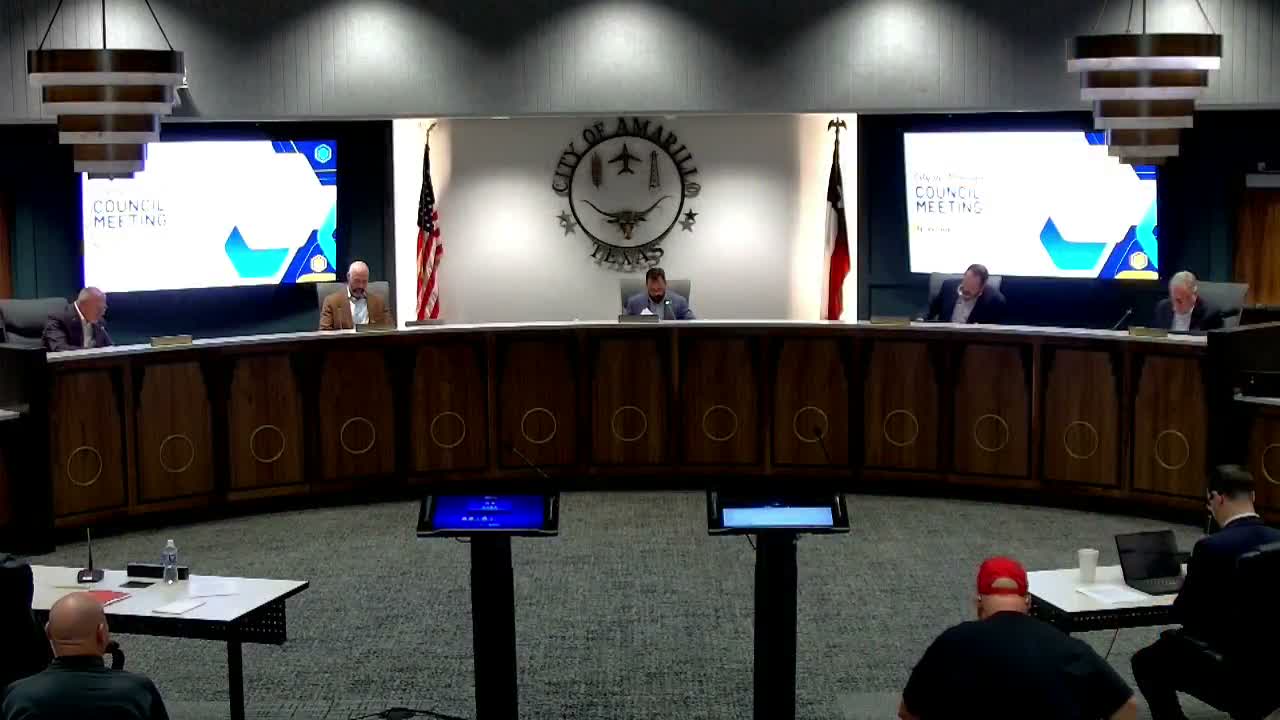
City utility staff gave a detailed update on Nov. 18 about plans to upgrade Amarillo’s aging wastewater system and to build new treatment capacity in phases.
Donnie Hooper and the city’s consultant team described a pivot away from a single centralized plant toward rehabilitating the existing Hollywood and River Road plants while constructing new capacity sized for 10–15 years of projected growth. Hooper said Hollywood has met the Texas Commission on Environmental Quality’s (TCEQ) trigger for planning (the 75% permitted average‑daily flow threshold) and the department has begun engineering, permitting and funding work required by state rules.
Staff reported a River Road assessment that cataloged more than 660 assets across electrical, mechanical and structural categories and identified short‑to‑medium term capital needs to keep both plants functional during phased construction. The utilities team said it is pursuing multiple funding sources: a possible Texas Water Development Board general‑revenue grant (~$20M) for design, a Clean Water State Revolving Fund low‑interest loan application (~$60M), and preliminary discussions with the U.S. Army Corps of Engineers for ~$38M targeted at flood‑mitigation work at Hollywood.
A draft schedule showed preliminary engineering and master planning under way now, permitting to follow (estimated ~18 months), and phased construction beginning in earnest in 2027 with major plant work through early 2030s depending on funding and approvals. Staff emphasized the project will be staged to keep existing plants operational and noted an OPCC (opinion of probable cost) will be required before the council can adopt a firm budget. The current planning goal is to hold total project costs below $1 billion if feasible through phased design, use of existing facilities and CMAR (construction manager at risk) contracting.
Councilors also discussed rate impacts and the timing of a rate study; staff said the recent rate increase established a recurring funding stream (roughly $5M per year from the 5% increase) that will be used partly for capital and to position the city for future debt issuance and debt‑service mitigation.
Ending: Staff will finalize the Preliminary Engineering Report (PER), continue funding applications, bring back the OPCC when available, and present a funding/implementation timetable to council for decisions on rate pathing and debt issuance.