Get Full Government Meeting Transcripts, Videos, & Alerts Forever!
Get email alerts on the Municipal Finance topic
No spam. Unsubscribe anytime.
Oro Valley residents and officials weigh revenue options, annexation and transparency for 10-year plan
Summary
Town staff and residents met online to refine priorities for Oro Valley nd to advise a 10-year plan; discussion focused on financial transparency, alternative revenue sources (use tax, bonds, franchise fees, annexation, tourism/economic development), and trade-offs for preserving core services.
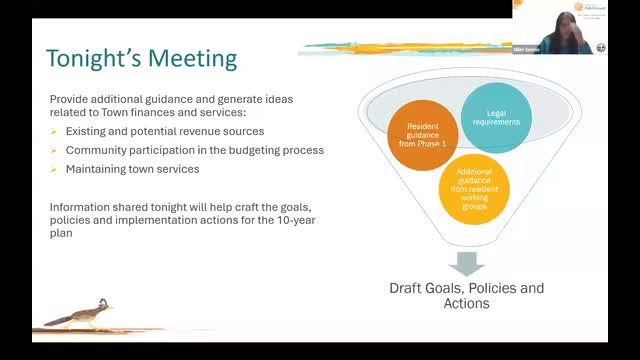
Malini Sims, principal planner for the Town of Oro Valley, opened an online workshop where residents and town staff reviewed last year—ommunity survey results and discussed revenue options and cost-saving measures to inform the town—0-year plan.
The meeting centered on three pressing fiscal themes: clearer public financial reporting, ways to increase or diversify revenues, and how to prioritize projects without eroding essential services. Sims said the survey behind the discussion included more than 90 responses and that the statistically projectable results represent roughly 19,300 Oro Valley adults.
Residents urged more granular financial transparency and reporting. Joyce Garland asked for a website that lets citizens "drill down to specific aspects of the financial transactions and data," saying current budget documents are high-level. Another participant suggested benchmarking Oro Valley against similarly sized cities so residents can "see both perspectives" about allocations and priorities. Sims confirmed staff will add a public-facing, more detailed transparency item to the draft plan.
Panelists debated revenue options rather than immediately proposing new taxes. Several participants noted that Oro Valley is largely sales-tax based and that commercial land accounts for "less than 10%" of built area, which limits the town bility to expand retail tax revenue without changes in land use or annexation. Bill Rodman and JJ Johnston urged the town to pursue annexation of revenue-generating parcels and to consider tourism investments such as a performing-arts venue to boost bed and retail taxes.
On the subject of property tax, multiple participants said historical ballot efforts in Oro Valley have failed and urged caution about treating it as a likely near-term option. Don (a resident) emphasized a common misconception, saying residents "believe that the property tax that we pay twice a year ... accrues to Oro Valley—enefit," and clarified that the town does not currently collect a local property tax. Staff and other participants urged that annexation and economic development remain options while acknowledging the costs of providing services to newly annexed areas.
Participants discussed other revenue tools, including a local use tax, franchise fees and grants. Kristen Sharp explained a use tax is intended to level the playing field for businesses that procure goods out of state, and others said municipalities can collect meaningful revenue from such policies. Dave Gephardt, the town—hief financial officer, and other finance-experienced participants recommended treating bonds as financing tools rather than revenue and stressed that bonds should be used for capital projects with explicit repayment plans tied to the appropriate revenue stream.
Speakers urged the group to think about cost controls and efficiency alongside revenue. Suggestions included program-based budgeting (one participant urged converting a line-item budget into a "program performance budget" with metrics), procurement reviews, contract renegotiation, and exploring technology and AI to reduce overhead and improve service delivery without cutting essential programs.
Equity and prioritization of projects were recurring themes. Several residents asked that capital spending consider geographic equity across Oro Valley nd that essential systems such as police, water and roads be prioritized over discretionary amenities. Rosa (Bridal Daley) asked that annexed neighborhoods be considered equitably when parks and services are planned.
Staff outlined next steps: economic development will be the focus of a March meeting, annexation and land-use discussions will continue in April, and staff will work over the summer to reconcile inputs from various working groups and return consolidated goals, policies and actions by late summer. The working group will meet again in two weeks, Sims said.
The meeting recorded no formal votes or motions; participants were invited to review the whiteboard content posted online and to continue contributing feedback through the OVPathForward resources Sims noted.
Quotes in this piece come from participants during the workshop and are attributed to the speakers who identified themselves during introductions and discussion.