Get Full Government Meeting Transcripts, Videos, & Alerts Forever!
Get email alerts on the Short Term Rentals topic
No spam. Unsubscribe anytime.
Consultant tells Carrollton council STRs draw more code violations and service calls; recommends background checks and targeted enforcement
Summary
A criminologist's three-year review found 81 short-term rentals in Carrollton, elevated code-enforcement citations and calls for service concentrated in ZIP code 75010, and recommended background screening, targeted ZIP-code enforcement and anti-trafficking protocols; city attorney discussed child-safety-zone authority.
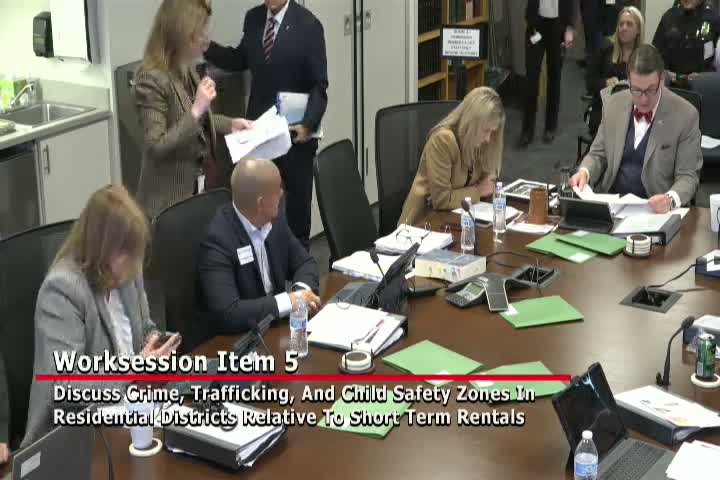
The council heard a consultant's three-year analysis of short-term rentals (STRs) and public-safety implications for Carrollton.
Dr. Alex Del Carmen, a criminologist hired by the city, told the council his review found 81 STRs citywide across the past three years, with a cluster of higher noncompliance in ZIP code 75010. He said about 38% of STRs were non-violators but the majority had at least one ordinance violation during their recorded history; STRs received code-enforcement citations at an annual rate that suggested disproportionate attention and generate 4 to 5 times more calls for service than non-STR properties in the dataset.
"We saw a volume of information regarding anonymous booking systems, transient occupancy, all of which affect the target suitability premise," Dr. Del Carmen told the council, noting sample-size limitations that make citywide statistical comparisons difficult. He recommended a package of reforms including enhanced background screening for guests, guest identification verification, mandatory anti-trafficking awareness training, proactive compliance audits for repeat violators, geographic risk management focused on ZIP code 75010 and increased penalties or license suspensions for persistent unlicensed operators.
City Attorney Meredith Webb briefed council on the city's legal authority to regulate child-safety zones for registered offenders and noted many home-rule cities adopt a 1,000-foot buffer around places where children commonly gather; she said courts have upheld similar buffer regulations in nearby jurisdictions (citing Duarte v. Lewisville). Staff discussed operational steps municipalities use elsewhere: minimum-stay requirements (e.g., five nights), owner- or platform-required background checks at booking, signage and suspicious-activity reporting protocols used in hotels, and license-revocation authority for repeat violations.
Council members asked about enforcement practicality and data limits; staff and the consultant said small STR counts limit some comparative analysis but recommended targeted enforcement and platform-level compliance measures to reduce enforcement burden and risks to neighborhoods.
Next steps: staff will incorporate consultant recommendations into the ongoing STR review, evaluate ordinance language options (licensing, background checks, minimum stays, density caps), and return with draft regulatory options and enforcement cost estimates.