
Committee advances overhaul of Utah Fits All scholarship with new guardrails
Get AI-powered insights, summaries, and transcripts
Subscribe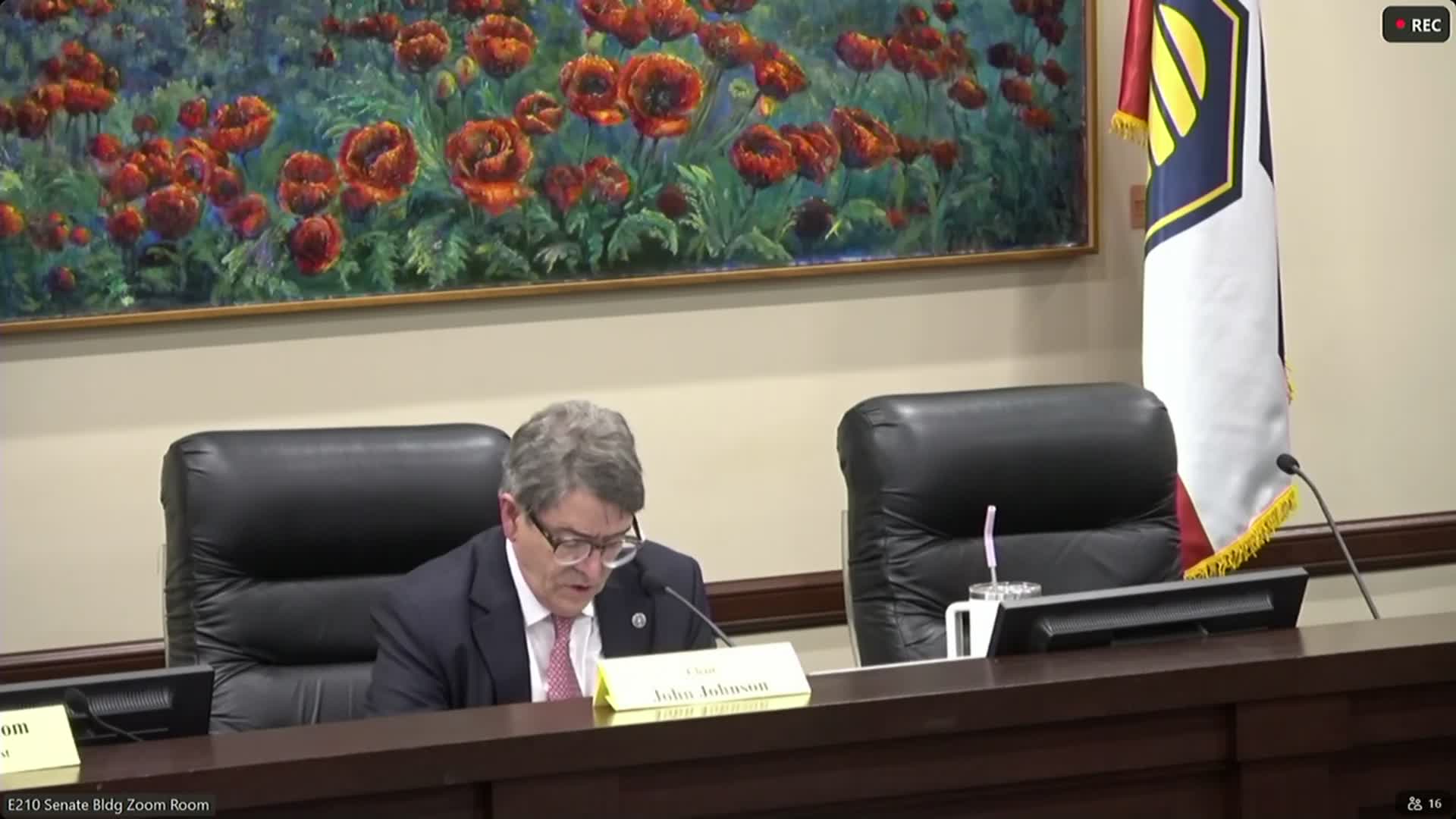
Summary
The Senate Education Committee recommended House Bill 467 (fourth substitute) favorably after sponsors removed accreditation requirements for private schools, added eligibility checks for private providers, strengthened customer-service and reimbursement rules for the program manager, and required annual legislative audits of the Utah Fits All Scholarship program.
The Senate Education Committee on its final week of session voted to send House Bill 467 (fourth substitute) to the full Senate with a favorable recommendation after Representative Perucci presented the measure as a cleanup and accountability package for the Utah Fits All Scholarship program.
Representative Perucci described the substitute as a year‑two refinement of the program, saying more than 15,000 students participate and that the bill clarifies preapproval procedures, tightens private‑school reimbursement eligibility and protects scholarship dollars from pass‑through providers. The bill removes an accreditation requirement and replaces it with a set of criteria (families must show four of five items such as proof the school is a registered Utah business, a published tuition schedule, documentation of at least 17 students, nonresidential operation, or two years of continuous operation) to qualify private providers for tuition reimbursement.
The substitute also requires the program manager (identified in testimony as Odyssey) to maintain customer‑service capacity, process reimbursements within 10 days, create a preapproval process for purchases, and operate a marketplace that may not sell used or returned goods. The sponsor said the State Board of Education, as contract holder, will coordinate on policy interpretations and compliance and that the Office of the Legislative Auditor General will perform annual audits to improve fiscal stewardship.
Supporters at the committee hearing included private‑education advocates and several parent organizations, who lauded removal of the accreditation requirement and praised the program’s flexibility. John England of the Libertas Institute testified he supported the fourth substitute and the removal of an accreditation barrier. Corinne Johnson (Utah Parent Society) and other witness organizations said the changes strike a balance between innovation and closing program loopholes.
Opponents and some committee members questioned transparency about student academic outcomes and how the program’s effectiveness will be measured. Senator Reedy asked whether the bill changes relative scholarship amounts for private, homeschool and public options; the sponsor said the tiered amounts (e.g., private school families receiving $8,000, homeschool elementary $4,000 and homeschool high school $6,000) were set in prior legislation and remain in place. Senator Reedy also asked about extracurricular participation rules and whether scholarship students would be subject to the same tryout and eligibility rules as homeschool or private‑school students; the sponsor said existing LEA accommodation policies would apply.
Senator Baldry moved the bill to the full Senate. The committee recorded a 5–1 vote in favor with Senator Eby recorded in opposition.