Get Full Government Meeting Transcripts, Videos, & Alerts Forever!
Get email alerts on the Establishment Clause topic
No spam. Unsubscribe anytime.
Presenter says courts have misapplied the Establishment Clause, warns "wall of separation" misleads
Summary
A presenter explained that the First Amendment's Establishment Clause bars government from establishing religion, criticized the "wall of separation" metaphor as misleading, and said courts relied on the Lemon test until it was overturned in Kennedy v. Bremerton School District.
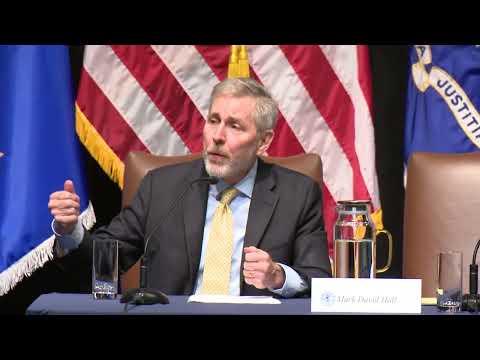
Presenter answered a question about the Establishment Clause by saying the common “wall of separation between church and state” metaphor misstates the amendment and has led courts astray. “The wall of separation between church and state, it really does not communicate at all the words of the Establishment Clause,” the Presenter said.
He quoted the text of the clause: “Congress shall make no law respecting an establishment of religion,” and said that phrase is a unilateral restriction on government action. “It’s a restriction on Congress and, through the doctrine of incorporation, now the states,” the Presenter said, adding that the clause is not a restriction on churches, synagogues, mosques or other religious organizations: “In no way, shape, or form is it a restriction on churches…”
The Presenter argued the wall metaphor suggests a two-way barrier—limiting both government and religion—but that literal readings produce absurd results. He asked rhetorically whether a literal wall would mean fire departments couldn’t put out fires in churches or that churches are exempt from building codes, to illustrate the practical problems with that interpretation.
Discussing legal doctrine, the Presenter said the Supreme Court’s mid-20th-century adoption of the metaphor (often associated with Justice Hugo Black) contributed to analytically rigid tests. He said courts relied for decades on the Lemon test, an analytical framework the Presenter described as having “done a lot of damage.” He added that the test was ultimately eliminated by the Supreme Court in the case commonly referenced as the Kennedy case involving a coach, referring to Kennedy v. Bremerton School District.
The exchange was explanatory rather than procedural; the remarks clarified doctrinal history and current doctrine but did not record any formal action or vote.