
Defense counsel tells court Massachusetts age‑based gun‑license ban is unconstitutional; commonwealth argues no standing and historical basis
Get AI-powered insights, summaries, and transcripts
Sign Up Free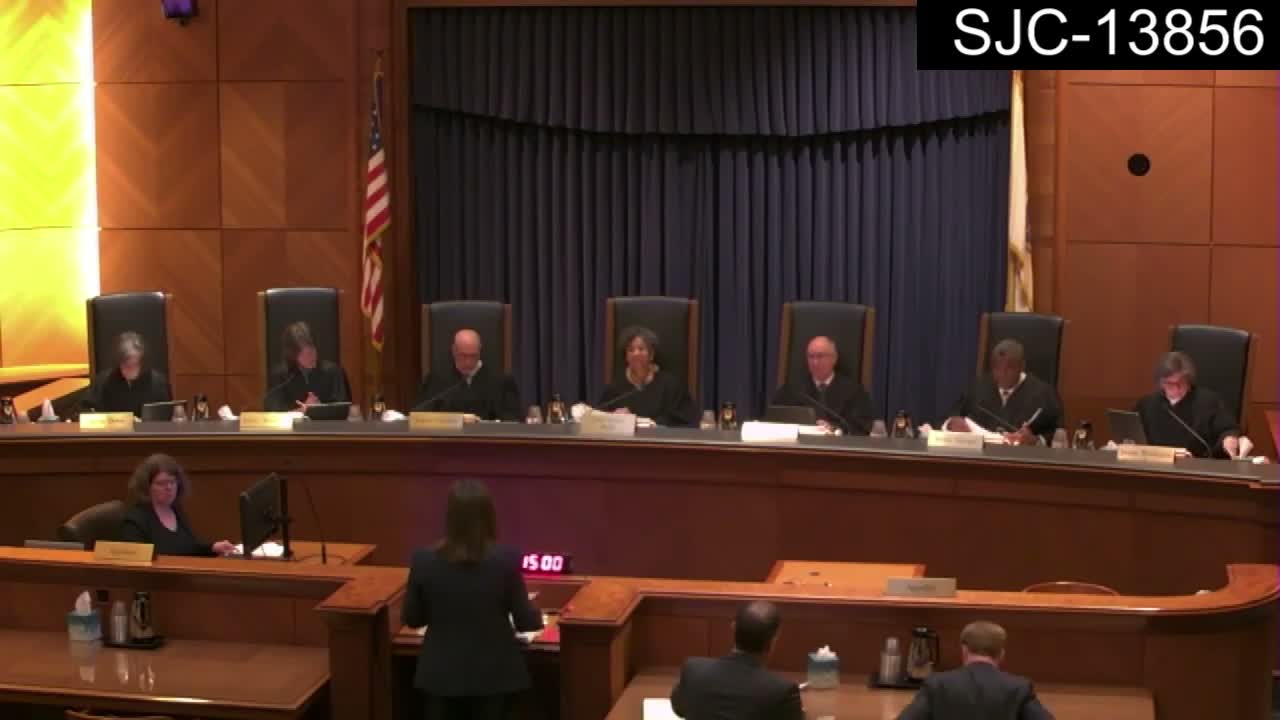
Summary
At oral argument in Commonwealth v. Thompson, defense counsel Elizabeth Ozar urged the court to vacate a conviction that relied on a statute categorically barring people ages 18–20 from handgun licenses; the Commonwealth's Ian McLean countered that Thompson lacks standing because he never applied and that historical analogs support the restriction. The court pressed both sides on precedents, remand, and the Bruen historical‑analogy test. Decision pending.
An attorney for the defendant told the Supreme Judicial Court that a Massachusetts provision barring persons ages 18–20 from obtaining a handgun license is unconstitutional and that her client, whose conviction relied on the age‑based ineligibility, has standing to challenge it despite never applying for a license.
Elizabeth Ozar argued that the Commonwealth put the age‑based ineligibility at the center of its prosecution and jury instruction, so the statute inflicted a direct, individualized harm that permits an as‑applied challenge. She told the court the Commonwealth offered no evidence at trial that Mr. Thompson was ineligible for a license for any reason other than age and that prior precedents leave room for a futility doctrine allowing a challenge when applying would have been futile or impossible.
The nut of the dispute, Ozar said, turns on the Bruen framework for Second Amendment claims: the Commonwealth, she argued, failed to point to relevant historical analogs showing that the nation's tradition permits a categorical rule disarming adult persons in the 18–20 cohort. Ozar urged that statutes criminalizing transfer or sale to minors and militia obligations differ in important ways from a modern categorical license prohibition and therefore are not adequate historical analogs for the blanket bar at issue.
Ian McLean, arguing for the Commonwealth, responded that Thompson lacks standing because he never sought the license and that Massachusetts has long required that a person apply and be denied before raising an as‑applied constitutional challenge in the licensure context. McLean warned against creating a statewide futility exception that would, in his view, encourage individuals to flout orderly licensing procedures, which include public‑safety courses and administrative screening.
On the merits, McLean urged the court to find relevant historical analogs that support restrictions aimed at keeping firearms out of the hands of certain groups, including statutes limiting transfers to minors and historical loyalty or militia‑based measures. He cited Rahimi and other post‑Bruen decisions as frameworks for identifying historically grounded regulations that accomplish the modern goal of public safety.
Throughout argument, the justices pressed both sides on the doctrinal lines between facial and as‑applied challenges, whether prior cases such as Marquis, Powell and Lara compel a particular result, how precise an historical analog must be, and whether the present record contains sufficient historical evidence to resolve the Bruen inquiry without remand. At several points the court asked whether a remand would be necessary to assemble a fuller historical record and whether resolving standing first would make a merits inquiry unnecessary.
The court heard argument from both sides and posed extensive questions; no decision was announced at argument, and the matter remains under advisement.
Claims and evidence in the argument are drawn from the oral‑argument record: defense counsel said the Commonwealth relied solely on age at trial; the Commonwealth said the defendant never applied and therefore lacks standing; both sides disputed which historical statutes qualify as Bruen analogs. The court indicated remand or additional historical evidence might be necessary if the merits are reached.