Get Full Government Meeting Transcripts, Videos, & Alerts Forever!
Get email alerts on the Election Administration topic
No spam. Unsubscribe anytime.
Election Assistance Commission training outlines steps to reconcile mail ballots
Summary
A presenter for the Election Assistance Commission (EAC) explained standard operating procedures, bipartisan verification, recordkeeping, and technology checks election offices should use to reconcile mail ballot applications, issuance, returns and scanned ballots, noting states set specific rules and federal retention is generally 22 months.
A presenter for the Election Assistance Commission (EAC) outlined practical steps election offices should use to reconcile mail ballots and any required ballot applications, saying the work is essential to ensuring certified results include every valid ballot and only valid ballots.
"Mail ballot reconciliation is the process election officials use to keep track of each mail ballot that has been issued to a voter," the presenter said, and described reconciliation as occurring at multiple points: when ballots are issued, when return envelopes are received, and when ballots are opened and scanned.
The presenter listed four preparatory steps offices should take before voting: develop standard operating procedures and training; involve multiple personnel (ideally bipartisan teams) at each step; create thorough documentation; and understand the technology involved. On documentation, the presenter noted, "Generally, federal law requires election officials to retain federal election records for 22 months," and added that state laws may require longer retention.
On procedures and staffing, the presenter urged offices to adopt contingency plans for damaged ballots or technology failure and to require crosschecks, such as two workers verifying scanner counts against the number of ballots accepted for counting. "For accountability and accuracy, consider creating a process that involves multiple personnel at each step working in bipartisan teams if possible," the presenter said.
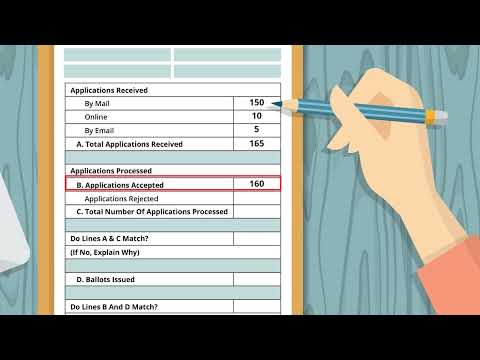
The training offered concrete examples for daily practice. For issuance reconciliation, the presenter described logging applications by source and comparing accepted applications to ballots issued, using an example count of "150 received by mail, 10 received online, and 5 received by email for a total of 165 applications" and instructing offices to record accepted and rejected applications (for example, those missing signatures).
For returns and scanning, the presenter recommended recording totals of envelopes received from mail, drop boxes and in-person drop-offs, documenting accepted, rejected and set-aside items, and batching envelopes before opening. In an illustrated scanning example the presenter described two batches (80 envelopes and 20 envelopes) that together should have produced 100 scanned ballots, but the scanner reported 99 because one envelope did not contain a ballot; staff should document such discrepancies immediately.
The presenter also recommended scanning ballots in standard batch sizes (for example, 20, 50 or 100) to make it easier to detect discrepancies early, to record the container in which a scanned batch is stored, and to maintain a chain-of-custody form signed or verified each time a batch changes hands.
The training repeatedly cautioned that specific reconciliation steps and forms may be set by state rules and that offices should adapt these practices to local legal requirements. The presenter closed by thanking viewers and urging election staff to implement consistent, documented reconciliation practices to support transparent, accurate election results.