
Hillsborough County zoning hearing reviews multiple rezoning and plan‑development requests
Get AI-powered insights, summaries, and transcripts
Subscribe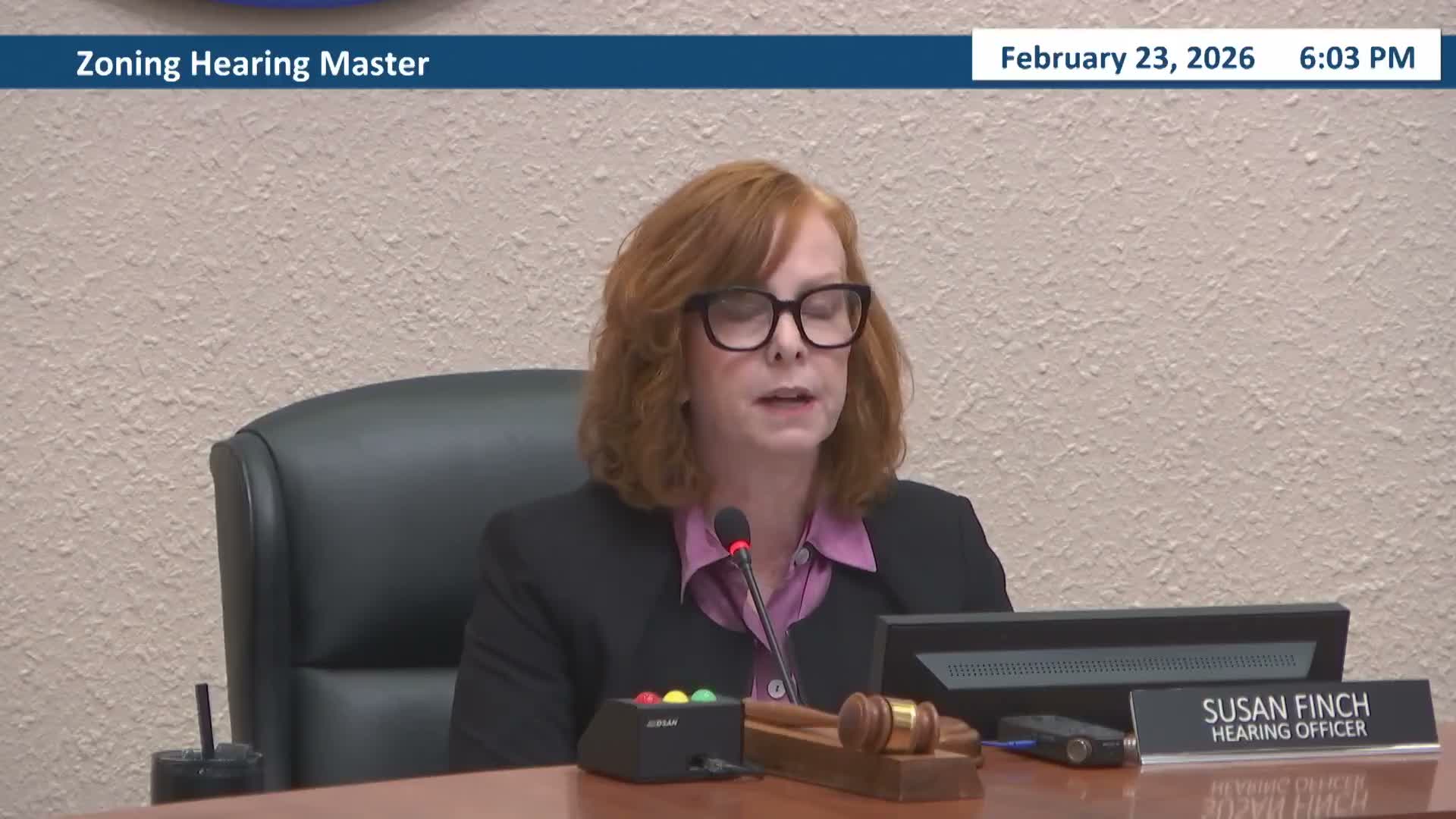
Summary
At a Feb. 23 zoning hearing master meeting, county staff and applicants presented several rezoning and plan‑development requests — from a six‑unit apartment rezoning and a neighborhood dance‑studio PD to contractor‑office rezonings and a large industrial PD expansion — with staff generally recommending approval subject to conditions; no formal board votes were taken at the hearing.
HILLSBOROUGH COUNTY — At a Hillsborough County zoning hearing master on Feb. 23, 2026, applicants and county staff reviewed a slate of rezoning and plan‑development requests ranging from small neighborhood projects to large industrial expansions; the hearing was strictly evidentiary, and the Board of County Commissioners will consider land‑use hearing officer recommendations at a later public meeting.
The hearing master opened by explaining public‑comment rules and swearing in speakers. Mary Dorman of the county attorney’s office told attendees that testimony and documentary evidence entered tonight “become part of the complete factual record” and reminded parties that additional evidence cannot be added after the record closes; she said the board is scheduled to hear these items at its April 7, 2026 land use meeting unless staff states a different date.
Several routine rezoning requests moved through the record with limited or no public opposition. In case C1 (rezoning 26‑0297), applicant Aileen Rosario asked to rezone a parcel from RSC‑9 to RMC‑20 to permit six one‑ and two‑bedroom apartments. Development Services staff (Michelle Heinrich) and planning commission staff (Willa Mickey) reported the request is consistent with the Res‑20 future land use designation and recommended approval; no neighbors spoke in opposition.
A small commercial/industrial request from True Builders (PD rezoning 24‑0921) drew more extensive presentation. Owner Isaac Turpin and engineer Ryan Renardo described plans to rezone roughly 2.45 acres from ASC‑1 to a planned development to allow a contractor’s office (no outdoor storage) with a 20,000‑square‑foot cap and a proposed floor‑area ratio of 0.187. The applicant requested two buffer‑width variations to accommodate road and sidewalk geometry and committed to a 70‑foot setback, a stormwater pond and a 6‑foot solid vinyl fence adjacent to the nearest single‑family residence. Sam Ball of Development Services recommended approval subject to conditions; planning commission staff noted the site does not meet commercial locational criteria but said the applicant requested a waiver under policy 22.8 and that neighborhood coordination produced letters of no objection. The applicant emphasized the lack of opposition and said neighbors and a nearby church had signed adjacent‑neighbor statements.
A PD‑to‑PD rezoning (RZPD250582) for ProTech/contractor and warehouse uses was presented by attorney Colin Rice. He said the future‑land‑use category was changed last year to a light industrial plan (LIP) and that the application limits open storage location and provides a 30‑foot buffer; staff recommended approval and planning commission staff agreed the proposal is consistent with LIP policies.
The hearing also included a major modification to PD83‑0173 (Dr. Martin Luther King Boulevard) to authorize additional light‑industrial uses and add an alternative development option. Cammy Corbett, the applicant’s attorney, said the modification includes conditions that prohibit truck access to Chelsea Street and require buffers and truck‑routing measures; staff recommended approval with conditions and planning commission staff found the modification consistent with policy.
In Brandon, a family‑run dance studio sought a neighborhood‑scale PD to permit interior build‑outs at 911 Bridal Road. Brentwood and Hannah Townend described limited interior renovations (no footprint change) to convert a single large room into multiple studios. Planning staff (Tanya Chappella) and planning commission staff supported the request as a low‑impact neighborhood use; two speakers from the neighborhood (Nicholas Karas and Jessica Benitez) spoke in favor, noting students often walk to class.
A significant comprehensive plan amendment and major modification in the Town and Country area would reclassify roughly 45.5 acres from RES‑9 to RES‑16 to bring an existing mobile/modular community into conformance with how it is already developed. Nicole McInnis and David Smith said the site effectively operates at 669 equivalent dwelling units; staff (Jared Follin) supported the request pending approval of the companion CPA (CPA2534). Questions from the hearing master focused on unit‑count equivalencies, setback standards for parcel A, and whether the Pavilion building in parcel B might be converted in the future; the applicant said any conversion would require compliance with the conditions in the record.
The final item was a large PD expansion in the East Lake Orient Park area (PD Rezoning 26‑0220) presented as a phase‑2 addition to an existing industrial PD. The applicant seeks to add roughly 57.85 acres and up to 380,000 square feet (phase 2) of warehousing, distribution and light‑industrial uses, matching an existing phase‑1 entitlement (another ~380,000 sq ft). Variations were requested to permit a PVC fence in lieu of a masonry wall along some buffers and to allow an increased stormwater‑pond slope within a buffer; staff recommended the application be approved subject to conditions, including restrictions on direct access and limits on truck routing. Staff also provided a corrected/revised report during the hearing clarifying a condition about preliminary vs. construction submittals.
No formal votes were taken at the hearing master level; the hearing master closed each item and the applications will proceed to the Board of County Commissioners (or the identified subsequent public meeting) for final action. Several items included standard conditions and technical reviews to be completed at later permitting stages (for example, stormwater design review and traffic signal warrants with FDOT for the large PD). The hearing record contains letters of no objection for a number of the small projects and multiple staff reports that conditionally support approval for the larger industrial and residential conformance requests.
What comes next: items that require board action will be placed on upcoming land‑use agendas (Mary Dorman noted April 7, 2026 as the typical board meeting date for these records; several items also have separate concurrent CPA or companion hearings and staff identified the specific next hearing dates in the record).