
Supreme Court of Texas hears dispute over whether deed phrase 'free of cost forever' bars post‑production charges
Get AI-powered insights, summaries, and transcripts
Sign Up Free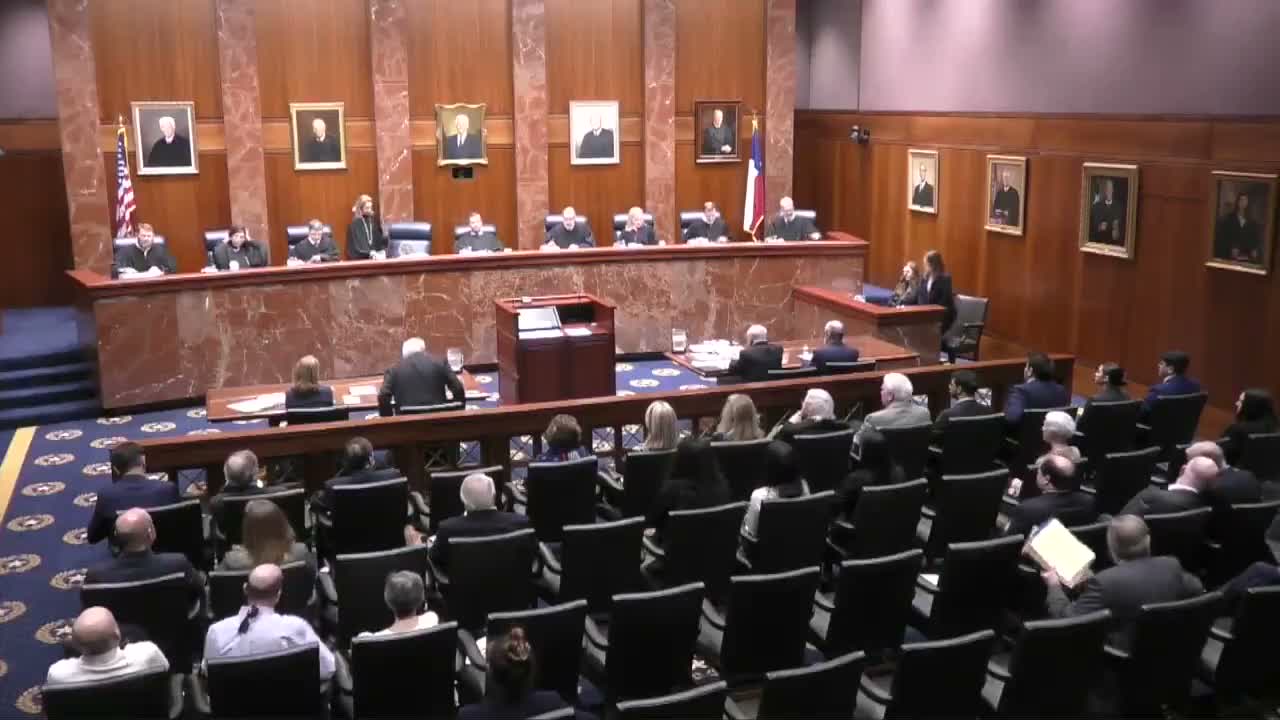
Summary
At oral argument in Faskin Oil v. Queen, counsel and justices debated whether a deed clause stating royalties are "free of cost forever" prevents the deduction of downstream processing and delivery costs, with parties disputing how precedent and contract context should control valuation and burden of proof.
The Supreme Court of Texas heard oral arguments in Faskin Oil v. Queen over whether a deed provision that royalties are "free of cost forever" prevents royalty owners from bearing post‑production costs such as processing, transportation and fractionation.
Petitioner counsel Alexander told the court the parties never agreed to "liberate" the royalty owner from post‑production costs and urged the justices to construe the deed language in context. "If you view it in isolation, 'free of cost forever' sounds like… production and post‑production costs," Alexander said, adding that established authority defines a nonparticipating royalty interest (NPRI) as entitling the owner to a share of production proceeds "free of expenses of exploration and production." He argued that, in the absence of an express agreement otherwise, the general rule from Hyder and related cases applies: royalties are free of production costs but must share post‑production costs.
Justices pressed both sides on valuation and mechanics. One justice quoted the deed phrase directly: "Free of cost forever," and asked whether the deed elsewhere shows the parties intended a different allocation. Counsel and the bench debated whether valuation should be determined at the wellhead (the classic "work‑back" method historically used for Faskin) or at a downstream sale, and whether the ability to take a royalty in kind affects who pays delivery and processing costs.
Respondent counsel (identified in the transcript as Glassman) answered that the decisive question is where the royalty is valued and how "proceeds" should be defined. Respondent emphasized that when parties specify gross proceeds or point of sale the contract controls valuation, and that the court's cases distinguish between free‑of‑cost language standing alone and free‑of‑cost language coupled with other provisions that point clearly to valuation choices.
Both parties and the justices spent substantial time comparing precedents — including Hyder, Heritage, Devon Energy, Bluestone v. Randle and others — to test whether the phrase "free of cost" standing alone is sufficient to exclude post‑production deductions or whether the operator must point to additional contract language to prevail. Counsel for the petitioner argued the burden should lie with the operator to show the clause does not mean what it literally says; the respondent argued the court's precedents create a framework of a general rule and an exception that depends on contract specifics.
The court also heard argument about practical effects: counsel noted that in gas cases processing can occur hundreds of miles downstream, creating substantial post‑production expenses, while justices asked whether broader public‑interest consequences (raised by an amicus brief by the GLO) would be implicated; petitioner responded that the GLO's statutory protections do not apply here.
After final questioning, the court took the case under submission for decision; the justices did not announce a ruling at the hearing.
Why it matters: The court’s forthcoming decision will clarify whether language like "free of cost forever" in deeds bars operators from passing downstream processing and delivery costs to royalty owners, or whether precedent and contract context require more specific contractual terms to prevent such deductions. That will affect royalty accounting and the allocation of significant downstream costs in Texas oil and gas contracts.
The case was submitted for decision; the court will issue its opinion in due course.