Get Full Government Meeting Transcripts, Videos, & Alerts Forever!
Get email alerts on the Digital Assets topic
No spam. Unsubscribe anytime.
CFTC roundtable: industry urges custody qualifications, not just named depositories, for digital assets
Summary
At a CFTC staff roundtable, regulators and market participants agreed the agency should focus on clear, capability‑based qualifications (capital, cyber, segregation, exams) for custodians of customer funds that include digital assets rather than rely solely on entity labels in rules such as 1.20(b). New York’s limited‑purpose trust model was spotlighted as one example of closer prudential oversight.
The Commodity Futures Trading Commission convened a staff roundtable where regulators, exchanges, clearinghouses and custodians discussed whether depositories named in CFTC rule 1.20(b) remain appropriate for holding customer funds that include digital assets.
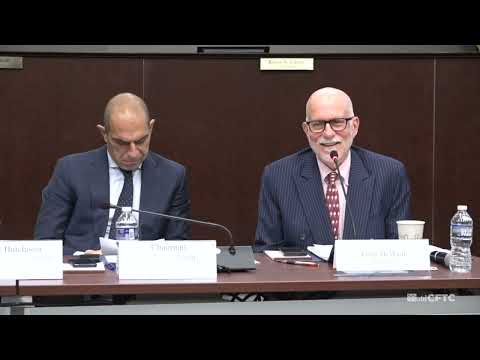
Clark Hutchinson, who opened the meeting for the CFTC’s Division of Clearing and Risk, turned the session over to Chairman Benham, who framed the agenda around “new structures, new ideas” that could reshape clearing and custody. Chairman Benham said the agency wants “an inclusive tent” to gather ideas while weighing law, policy and risk.
The first substantive session focused on custody and the role of entities that may hold customer funds. Caitlin Asro, executive deputy superintendent for research and innovation at the New York State Department of Financial Services, described New York’s limited‑purpose trust charter and supervisory regime. Asro said those trusts “have unique legal structures as well as technical capacity” for custody and noted New York’s emphasis on segregation of customer virtual currency, robust cybersecurity and on‑site and off‑site monitoring. “We have supervision kind of expertise in BSA/AML, transaction monitoring, KYC, sanctions,” she said, summarizing the state’s multiyear approach to custody oversight.
Across the room, market participants urged the CFTC to focus on specific qualifications rather than only on a categorical list of permitted depositories. Zach Dexter, a representative of a clearing organization that previously handled physical bitcoin custody, said the finality of many digital‑asset protocols “is very extreme” and argued there is “a good use case for a purpose‑specific custodian that is solely focused on cybersecurity and backups.” Several exchange and DCO representatives agreed, stressing capital, insurance, cyber readiness and clear segregation of customer holdings as central requirements.
Some participants urged a mix of principles and targeted prescriptive rules. David (surname not specified in the transcript) argued for a principles‑based approach but recommended the Commission “be a bit more prescriptive, where you see the right lines being drawn,” so market participants can design systems to those boundaries in advance. Others, including NFA, said the protections customers now receive for traditional financial assets must be preserved for tokenized assets.
The panel also canvassed whether DCOs or FCMs should be the primary gatekeepers for different custody models. Views diverged: a number of participants said DCOs and FCMs should retain discretion to conduct due diligence, while others urged that the CFTC define explicit qualification standards or create a registration path for custodians of digital assets. New York’s model — annual examinations, continuous monitoring, and guidance on segregation and reserve treatment for regulated stablecoins — was repeatedly raised as a practical example the CFTC could study.
The roundtable did not produce a consensus rule proposal, but multiple speakers signaled general agreement with one core point: “It’s not the name of the entity that matters as much as the qualifications of the entity,” Gary DeWalt, the moderator, summarized. The Commission said it will consider the input as it develops an administrative record to support any potential rulemaking or guidance.
The roundtable will continue future sessions; staff said any formal proposals will be informed by the record developed from meetings like this one.