House DOC subcommittee adopts $523.4 million FY27 recommendation after four failed Prox amendments
Loading...
Summary
The House Department of Corrections subcommittee voted 7–1 to forward a $523.4 million FY27 operating recommendation and intent language to the full finance committee after rejecting four amendments from Representative Prox that would have cut or reallocated funds for IT reclassifications, personnel, restorative-justice funding sources and medical staffing.
The House Department of Corrections subcommittee on Tuesday adopted a fiscal year 2027 subcommittee report and operating-budget recommendation totaling $523,436,200 and forwarded the report and accompanying intent language to the full finance committee.
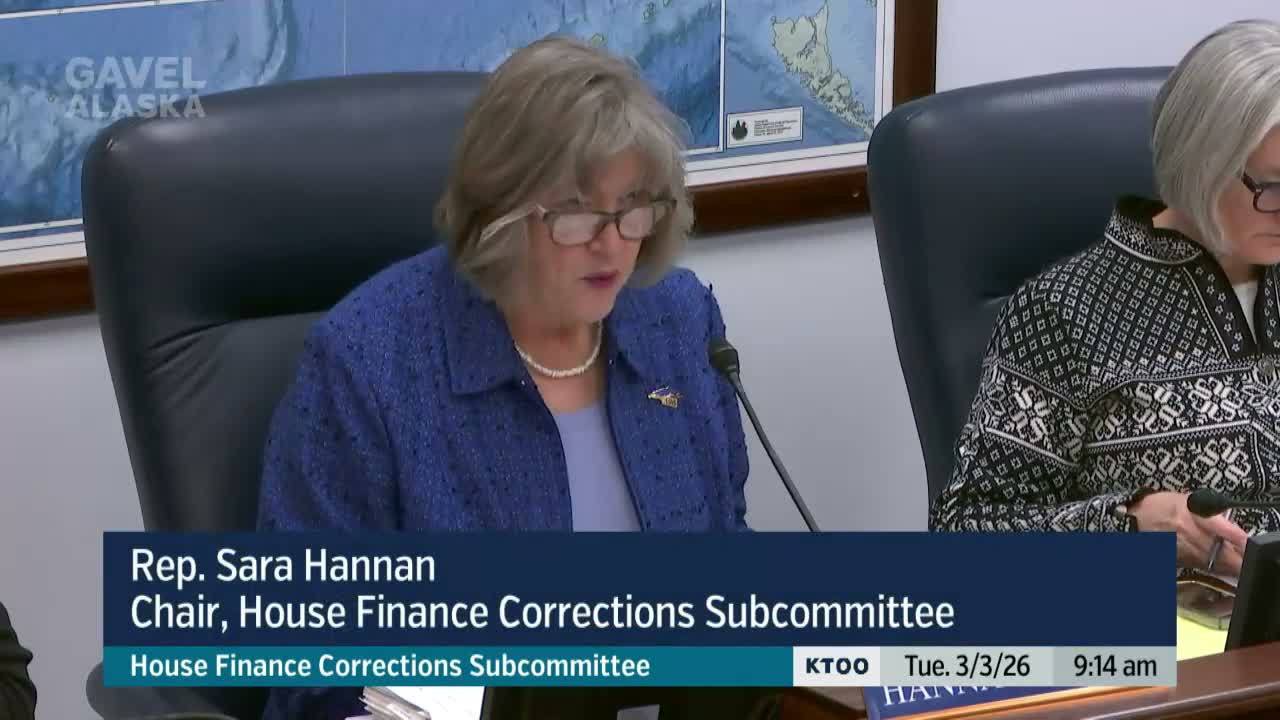
Chair Hannan opened the meeting and asked the subcommittee to adopt the chair’s proposal as the working document. Hunter Micham, staff to Chair Hannan, told members the recommendation accepts the governor’s request with no increments or decrements and includes $475,589,900 in unrestricted general funds, $14,170,200 in designated general funds, $24,293,200 in other funds and $9,382,900 in federal funds, and 2,127 permanent full‑time positions.
The vote to move the recommendation out of committee passed 7–1, after a series of floor amendments from Representative Prox were rejected. Representative Prox offered four amendments seeking to delete or reclassify funding: $120,500 to defer an IT classification-study implementation increment; $20,000,000 tied to personnel services and inmate transportation; $4,695,600 to realign funding sources with the restorative justice account; and $3,100,200 for medical-staffing costs in health and rehabilitation services. Each amendment failed on roll call, with the maker as the lone affirmative vote in each case.
Prox said the department and the administration had not identified measurable goals and performance metrics required under the Executive Budget Act, arguing "we don't really know what the final project is gonna be" for the IT increment and that the subcommittee needs more detail before approving added authority or funding. "These are just ad hoc requests," Prox said, urging the panel to require clearer goals and measurable outcomes.
Members opposing the amendments urged caution about cuts that could undermine operations. Representative Holland said the IT classification work is "essential to make sure that we are paying people appropriately" and stressed recruitment and retention concerns. Representative St. Clair noted prior budget reductions to corrections and said some restorations are intended to return the department toward appropriate funding levels.
Connor Bell, fiscal analyst with the legislative finance division, told the subcommittee the IT classification study has preliminary findings and "has not yet been finalized," and said the restorative-justice account amounts fluctuate with the permanent fund and statutory distribution rules.
Chair Hannan closed the meeting with broader remarks about corrections spending and policy, noting the department is a large and growing state fiscal obligation and that addressing mental-health needs and at‑risk youth upstream could reduce long‑term corrections demand. The subcommittee adjourned at 9:44 a.m.
The subcommittee forwarded the BA report and intent language to the full finance committee for further consideration.