
Tennessee Senate advances wide package of bills; measures on rescue squads, driver licensing for inmates and education standards pass
Get AI-powered insights, summaries, and transcripts
Subscribe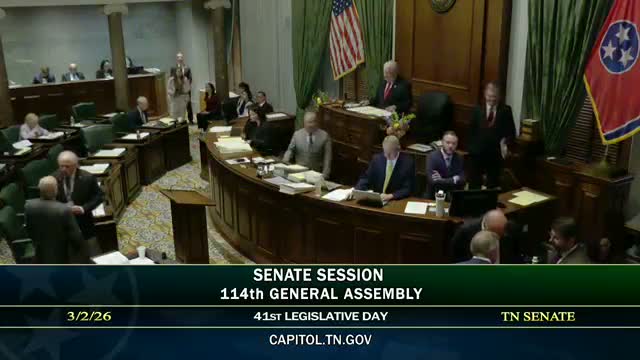
Summary
During a March 2 floor session the Tennessee Senate adopted a broad set of measures — many unanimously — including tighter rescue-squad standards, a pathway for renewed driver licenses for some people leaving incarceration, and new social-studies standards addressing communism; several bills were adopted as amended and one was deferred for further review.
The Tennessee Senate met in floor session on March 2 and approved a large calendar of bills, adopting many measures on third and final consideration and laying others over for future calendars.
Senators unanimously approved an amendment and passage of Senate Bill 1110 to establish official state recognition and oversight standards for rescue squads, Chairman Bailey said, adding the change “defines what qualifies as a rescue squad,” creates certification and reporting requirements through the State Fire Marshal, and preserves grant eligibility while allowing grandfathered exemptions for squads chartered before July 1, 2026. The Senate adopted the committee amendment and passed the bill (recorded vote: 32 ayes, 0 nays).
Lawmakers also approved a measure to help some people leaving incarceration retain or renew driver’s licenses. An amendment to the bill requires the Department of Correction to coordinate with the Department of Safety to provide or renew a driver’s license for individuals who held a valid license before incarceration. Chairman Gardiner said the change would “help more individuals leave incarceration with a valid driver's license” to aid reintegration; the Senate passed the measure as amended (32–0).
On education policy, the Senate adopted an amendment directing the State Board of Education to add new standards concerning communism to social-studies standards. Sponsor Senator Bolling argued the measure will ensure students learn “the history that will see that the warning from the former president never becomes a reality.” The bill passed, 27 ayes and 1 nay as recorded in the chamber.
Other notable actions included:
- Senate Bill 608 (commerce/auto franchise law): a Commerce Committee amendment that negotiated language between auto manufacturers and dealers was adopted and the bill passed unanimously.
- Senate Bill 609 (child custody): a judiciary amendment requiring courts to consider whether parenting schedules allow both parents to remain active in a child’s life was adopted; the bill passed unanimously.
- House Bill 1744 (Swedish rounding for cash sales): sponsors said the bill responds to reduced penny circulation and allows optional rounding to the nearest nickel for cash transactions only; it passed without objection.
- Senate Bill 1850 (kinship foster placements): a Judiciary Committee amendment clarified that relative caregivers and kinship foster parents are not required to provide a private bedroom unless safety or medical reasons exist; sponsors said the change eases placements with relatives. The amended bill passed (31 ayes, 1 nay).
- Senate Bill 2225 (DCS coordinated investigative teams): the bill makes inclusion of a nongovernmental organization with expertise combating commercial sexual exploitation mandatory on CPIT teams for trafficking cases, sets a 15‑hour annual training requirement for CPIT members, and extends certain DCS case‑closure timelines (from 60 to 90 days with possible extensions up to 180 days); it passed unanimously.
Leaders also handled routine floor business: several house bills were passed on first consideration and held on the clerk’s desk; consent calendars of memorializing and general bills were adopted; and Leader Johnson moved that delayed bills be considered by a committee after adjournment. The Senate agreed to adjourn until 8 a.m. Thursday for a joint convention to consider the governor’s judicial appointments.
A bill to allow campaign funds to pay for residential security expenses (cap $12,000 per year) drew questions about the cap and the definition of "residence"; Speaker Hale withdrew that bill for one week so sponsors and colleagues could discuss details.
What’s next: the Senate scheduled a joint convention with the House for Thursday morning to consider judicial confirmations; committee deadlines and budget hearings were announced by committee chairs.