Get Full Government Meeting Transcripts, Videos, & Alerts Forever!
Get email alerts on the Education Technology topic
No spam. Unsubscribe anytime.
Grandview Heights CTO outlines AI guidance, pilots teacher-facing tools and stresses student data protections
Summary
Chief Technology Officer Chris Dice presented the district's AI guidance document, said teachers will pilot a paid teacher-only tool (School AI) under student-data agreements, and emphasized human judgment, transparency and academic integrity in classroom use.
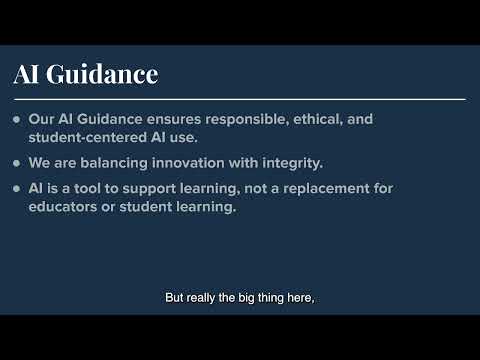
Chief Technology Officer Chris Dice told the Grandview Heights Schools Board that the district has produced an AI guidance document and is piloting teacher-facing tools while emphasizing student-data protections and human oversight.
"The first thing and foremost, anything technology is student data. So we want to make sure it's critical that we keep all of our student data protected," Dice said during an extended presentation on generative AI and how the district plans to use it. He described generative systems as an accelerating technology that can help teachers and administrators create lesson plans, rubrics and communications while warning that use must be governed by privacy rules and human review.
Dice said the district has signed a student-data privacy agreement for a paid pilot called School AI that teachers will access with educator accounts; students will not log in to that platform. "This is our first paid tool that we're going to pilot…Teachers do. Students don't log in to it," he said. The pilot, he added, is intended to help teachers create content, build rubrics and support individualized instruction while maintaining control over what is shared externally.
Dice outlined four priorities driving the guidance document: preserve human judgment in decisions using AI, foster personalized and engaging learning, cultivate AI literacy and ethical use, and uphold academic integrity and transparency when AI contributes to student work. He said the district has already added language about AI to the acceptable-use policy and is providing professional development, including an "AI academy" built into teacher late-start sessions.
Board members pressed Dice on whether students were already using external generative sites on district Chromebooks. Dice said the district's web filter blocks broad public domains, including sites like ChatGPT, for student accounts while allowing teachers to override when appropriate. He recommended standardizing a smaller set of district-supported tools to make professional development and collaboration easier.
On academic integrity, Dice said the district treats uncredited AI-produced work as plagiarism and is preparing grade-band guidance for classroom application. "When students use these tools and staff use the tools, we need to be transparent about using the tools," he said.
The presentation prompted questions from board members about teacher readiness, parent use of tutoring integrations (Dice said some teachers are already discussing those tools), and how the district will monitor bias and hallucination risks. Dice acknowledged limits and emphasized ongoing monitoring and training.
Next steps: the board received the AI guidance document and heard plans for the teacher pilot and continued professional development. The district will continue to refine acceptable-use language and training as pilots and teacher feedback proceed.