Get Full Government Meeting Transcripts, Videos, & Alerts Forever!
Get email alerts on the Education Mathematics Curriculum topic
No spam. Unsubscribe anytime.
Ridgewood math review recommends return to traditional algebra→geometry→algebra sequence and new Math 8
Summary
A five‑year math curriculum review presented to the Ridgewood Board of Education recommends returning to a traditional high‑school sequence (Algebra 1 → Geometry → Algebra 2), adding an eighth‑grade Math 8 course, adopting new Algebra textbooks and pursuing dual‑enrollment and AP expansion to improve student preparedness after low geometry scores under a prior sequence.
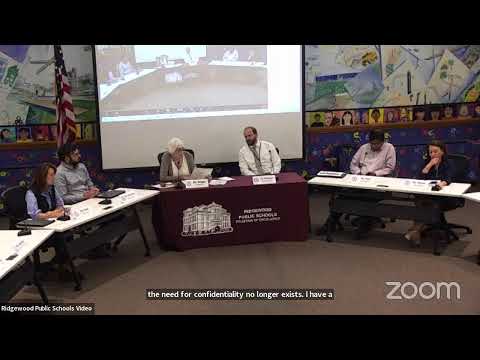
Ashley Anembo, who led Ridgewood’s math program review, told the board on June 10 that a data‑driven five‑year plan aims to strengthen students’ foundational skills and increase opportunities for acceleration.
"The first year of the math curriculum review is actually our current school year, 23‑24," Anembo said, summarizing research that included NJSLA results, internal benchmark data and surveys of parents, students and staff. Her analysis found geometry proficiency dropped sharply after the district shifted to a geometry‑first middle‑school sequence; algebra‑related scores were comparatively stable.
Anembo recommended returning to a traditional pathway—algebra 1, then geometry, then algebra 2—starting in 2024–25 for incoming cohorts, and adding a Math 8 quarter‑course for most eighth graders to shore up prerequisite skills such as linear equations and systems. She also proposed adopting the Envision math program for Algebra 1 and Algebra 2, piloting an AP Precalculus course and exploring AP Calculus BC, and expanding a dual‑enrollment option in calculus with Ramapo College.
The presenter tied the recommendation to multiple data points: state testing trends, two internal benchmark administrations that showed geometry learning did not improve under the prior sequence, and teacher and parent surveys. She said the return to a traditional sequence should improve transferability with other districts, increase opportunities for acceleration at the high‑school level and reduce scheduling conflicts for incoming transfer students.
Board members asked how the district will support students who experienced gaps under the geometry‑first model. Anembo said supports will include an eighth‑grade Math 8 elective, revised geometry curriculum materials that emphasize algebraic skills, expanded professional development for teachers and targeted extracurricular clubs and interventions to recover missed content. She also said the district will stagger some transitions so current cohorts finish the sequence they began, while younger cohorts move to the revised pathway.
No formal vote was taken at the meeting; the board received the report and discussed next steps including curriculum writing this summer, materials selection in 2024–25, and continued community outreach such as a proposed math parent night.
What’s next: the math department will begin curriculum writing this summer, continue professional development and bring materials and implementation plans back to the board for approval before major scheduling changes take effect.