Get Full Government Meeting Transcripts, Videos, & Alerts Forever!
Get email alerts on the Noise Control topic
No spam. Unsubscribe anytime.
Lake Jackson council directs city attorney to draft downtown noise ordinance after decibel study
Summary
After police presented decibel monitoring showing strong low-frequency bass carrying into nearby neighborhoods, Lake Jackson council directed the city attorney to draft an ordinance that would set time and/or property-line limits for amplified outdoor music while remaining consistent with state law.
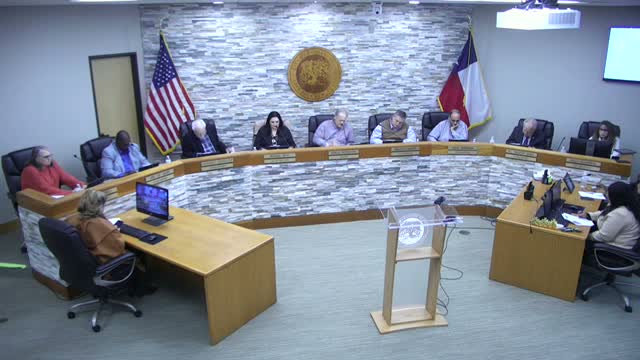
Lake Jackson — City council members on Feb. 2 directed the city attorney to draft a local ordinance to address amplified outdoor music in the downtown corridor after staff presented decibel monitoring and resident complaints showing that low-frequency bass was traveling into nearby neighborhoods.
Police and public-safety staff told the council their measurements at source locations reached roughly 99–101 decibels and that, in some residential backyards up to about 0.7 miles away, lyrics and bass could be heard. "At the source, you could see there's some that were a 101 decibels," the presenting officer said. The chief summarized enforcement options and suggested a tiered approach of warnings, citations and, if repeated, more severe penalties.
The council's discussion centered on two policy levers: numeric limits measured at property lines and time restrictions. "We could set a standard of 50 decibels at the property boundaries," the police presenter said when describing a potential numeric threshold. Several council members also said limiting amplified outdoor music by time—examples discussed included no amplified outdoor music past 10 p.m. Sunday through Thursday and past 11 p.m. Friday–Saturday—could reduce late-night disturbances while balancing downtown business activity.
City staff and council members repeatedly emphasized the role of the state-level statute that governs local regulation of amplified sound. One councilmember noted the city's tools under state nuisance law and the difficulty of outright bans. A council member summarized previous voluntary efforts: "Self regulation apparently is not an option," after noting owners of the establishments had not consistently reduced volume following prior requests.
Council members said they favored drafting an ordinance that would align with state limits while giving staff clearer enforcement tools. The motion directing the attorney to draft ordinance language authorized staff to include time-of-day and property-line decibel options and to return the draft for council consideration.
Next steps: the council asked staff to circulate a draft ordinance and to invite downtown business owners to the next meeting where the ordinance draft will be discussed. The council did not adopt a final ordinance at the Feb. 2 meeting.