Get AI Briefings, Transcripts & Alerts on Local & National Government Meetings — Forever.
Ad hoc committee recommends phased redevelopment of Lower Castaways, urges environmental review
Loading...
Summary
An ad hoc committee of Newport Beach City advanced a conceptual, phased plan to redevelop Lower Castaways park — including pads for a restaurant and coffee kiosk, expanded parking and a possible public dock — and recommended the plan be forwarded to City Council and that environmental review begin.
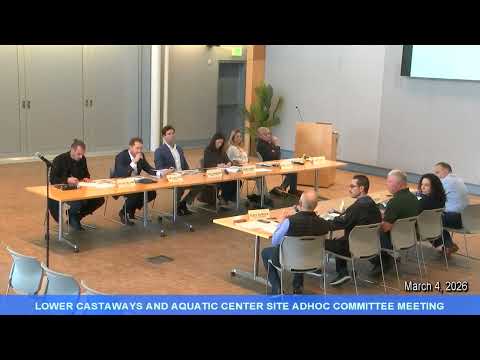
An ad hoc committee of Newport Beach City unanimously recommended forwarding a conceptual, phased redevelopment plan for Lower Castaways to City Council and authorized staff to start environmental review work.
David Webb, a city staff member presenting the plan, said the concept includes a restaurant pad of roughly 3,000 square feet (the city would build the pad, not the tenant’s building), a coffee kiosk, public restrooms, about 112 parking stalls and a potential 100-foot public dock located inside the city property line. "We would only build the pad, not the building itself," Webb said, describing how the city would prepare sites and later solicit operators by RFP.
The committee and staff discussed funding and phasing. City staff estimated roughly $26 million in future Quimby/park fees over five years could be available to support the project; staff described a phased approach in which an initial construction phase could cost about $9–12 million to complete seawall work, site grading and core infrastructure, with later phases adding improvements such as pads, lighting and landscaping. "We estimate about $26,000,000 in future fees," a staff speaker said; another staff member said a staging approach with a $9–12 million near-term package would be more palatable.
Regulatory review was a recurring concern: Webb and staff warned the committee the project would need permits from Fish and Game, the U.S. Army Corps of Engineers and the California Coastal Commission, and would require environmental review under the California Environmental Quality Act (CEQA). "We have to see what level of CEQA we have to do, either an EIR," staff said, noting that environmental analysis adds time and cost to any entitlement sequence.
Public commenters praised elements of the plan and urged caution on traffic and environmental impacts. Adam Leverenz said a public dock would be an "important amenity" if it can be accomplished and urged the addition of restrooms for staff and customers at the restaurant pad. Chuck Fanger, who serves on the city’s water quality and coastal committee, encouraged pervious parking and other treatments to protect water quality at the land–water interface. Other residents urged more green space and stronger community engagement on design choices.
Operational questions surfaced during the discussion. A representative for existing outrigger groups said two clubs currently lease launch space (one with four large boats, the other with nine to ten) and that lease fees are nominal (about $200 per month); staff said dedicated public kayak storage was not part of the immediate concept and would require separate lease terms or a competitive RFP.
After discussion, Chair Stapleton moved to recommend the conceptual plan, with a phased approach and a request that staff begin environmental review and prepare an entitlement timeline for City Council consideration. Committee members approved the recommendation by show of hands; the committee recorded unanimous support. The meeting adjourned with staff slated to prepare a phasing schedule and next steps for council consideration.
What happens next: staff will package the committee’s recommendation for City Council, scope CEQA work and return timelines and cost estimates for the phased entitlement/construction approach; a final funding plan will rely in part on future park (Quimby) fees, with the timing of work depending on permitting outcomes and budget cycles.