Get Full Government Meeting Transcripts, Videos, & Alerts Forever!
Get email alerts on the Higher Education Budget topic
No spam. Unsubscribe anytime.
CPE seeks inflation adjustments and two options to boost funding for smaller colleges
Summary
The Council on Postsecondary Education asked the interim Budget Review Subcommittee on Education for $43.3M (year one) and $86.6M (year two) in inflation adjustments and proposed two approaches to help smaller institutions: a $20M first‑year minimum distribution inside the performance fund or $5.6M in one‑time direct appropriations to selected campuses.
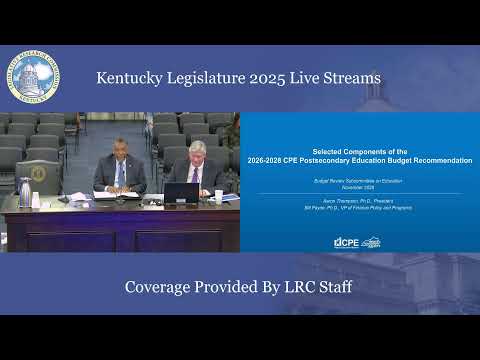
The Council on Postsecondary Education on Friday told the interim joint Budget Review Subcommittee on Education that rising campus costs and a widening gap between state support and inflation justify significant increases in the 2026–28 operating request.
Bill Payne, CPE’s vice president for finance, outlined an inflation adjustment request of $43.3 million in the first year and $86.6 million in the second — calculated as 4.5% and 9% increases applied across institutions — and recommended boosting performance funding by $30 million in year one and $45 million in year two.
"These funds will help to offset some of the largest increases in higher education cost that we've seen in over two decades," Payne said, citing a higher‑education price index that shows recent annual cost growth well above historical rates.
CPE proposed two options to ensure smaller institutions receive funding that the current performance model leaves them unlikely to earn. Under the first, CPE would add a $20 million, first‑year minimum distribution within the performance fund to provide level‑dollar allocations — $1,950,000 for each university and $4,400,000 for KCTCS — to address institutions that received no performance distribution in 2025–26. "We are asking that the general assembly create a minimum distribution pool within the performance fund," Payne said.
As an alternative, CPE offered a lower‑cost option: roughly $5.6 million in one‑time direct appropriations targeted to Kentucky State University, Morehead State University and five community colleges. CPE said it calculated those amounts as 4.5% of each institution’s 2025–26 net general fund appropriation.
Representative Tipton said smaller universities like Morehead and KSU meet many model metrics but get no money because the model’s weighting and volume favor larger campuses. Payne acknowledged that the original small‑school adjustment was reduced during early model design and said it has not been large enough to produce consistent distributions for KSU and Morehead.
CPE stressed that the direct‑appropriation option is recommended as a one‑time, nonrecurring measure while a working group reviews the performance model next year. Senator West pressed whether base increases would be recurring; Payne said the direct appropriations are nonrecurring and would not be included in the base unless the legislature makes them recurring.
Thompson and Payne framed the request as an investment in state economic development and student affordability, noting recent gains in retention and completion after prior reinvestments. "The idea of investing in higher education is investing in the state," Aaron Thompson, CPE president, said.
The committee did not vote on the CPE budget request during the meeting. The subcommittee received the presentation and questioned CPE staff about modeling details and distribution options; the CPE working group is expected to reconvene in 2026 to make longer‑term recommendations.